Pulse · techzine.eu
Latest in AI and developer tools
The top stories in the fields you follow, at 08:00 your time.
 Pulse · skift.com
AI booking is "definitely disruptive to our industry," Agoda's chief operating officer Ittai Chorev said at a media roundtable in Bangkok on Thursday. But
Read more Pulse · startupfortune.com
Swiss cyber chief Florian Schütz counts five AI agent attacks, three on critical infrastructure. Here is what BACS says companies should fix first.
Read more Pulse · hedgeweek.com
Feng Ji, founder of the $4bn Chinese quantitative hedge fund Baiont Quant, is developing an operating system designed specifically for artificial…
Read more Pulse · artificialintelligence-news.com
US banks are tightening AI agent security through access controls, transaction authorisation, threat detection, and cybersecurity response.
Read more Pulse · govinfosecurity.com
Changes to data, workflows and vendor systems can affect AI results after deployment. Patra CISO Sean Kennedy explains how leaders can monitor performance, assign
Read more Pulse · cio.com
The Dortmund-based IT service provider shows how companies can regain control over token consumption.
Read more Pulse · wisevoter.com
Developer Sasha Levin has asked for an agents branch to be added to linux-next, containing guidance that helps AI assistants follow kernel development rules.
Read moreLabor leaders and advocates urge protections for workers and consumers as AI use becomes more commonplace
Read more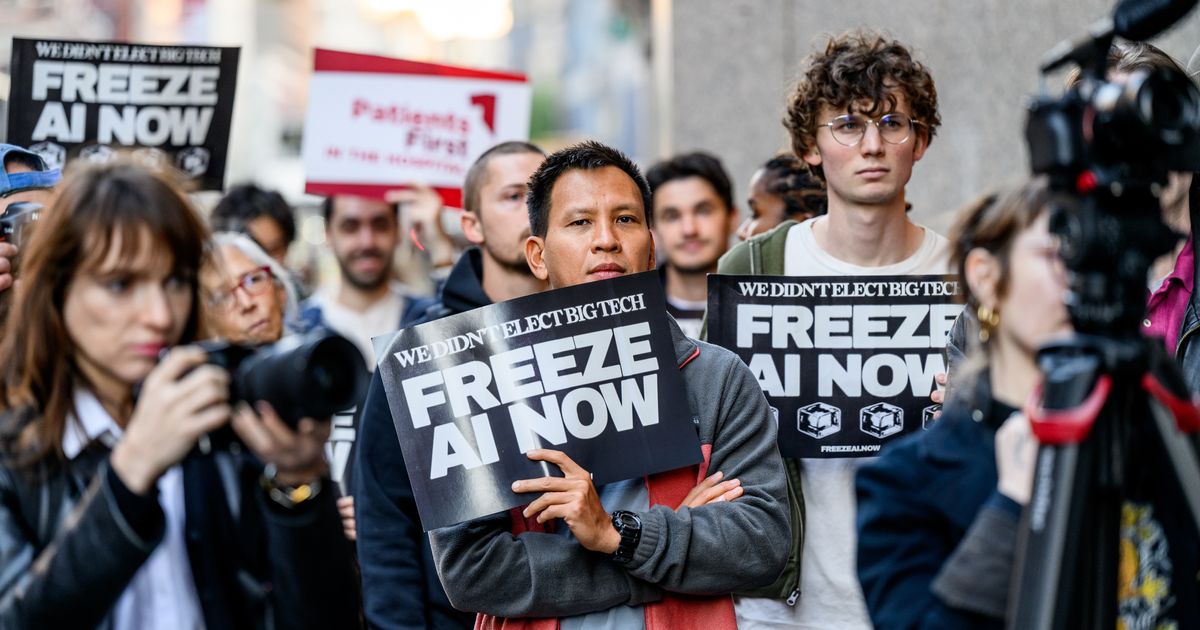 Pulse · nymag.com
New York's noisy, fractious City Council and the tort lawyers who flood our airwaves with cheesy ads (Have you been injured in an accident?) are not the army most of us would select as our best hope for saving humanity from possible destruction or enslavement by artificial intelligence run amok.
Read moreWe present AliceAI-Foundation-80B-A3B-Base, a mixture-of-experts language model with 80 billion total parameters and approximately 3 billion active parameters per token, trained from scratch at Yandex and released under the Apache 2.0 license. The model combines Kimi Delta Attention with full attention, uses Attention Residuals, and is trained with Muon. Training comprises general pretraining on 17.5 trillion tokens, two context-extension stages, and a dedicated stage for reasoning and agentic interaction. We describe the data collection and augmentation pipelines, evaluation protocols, architectural ablations, and scaling-law experiments. We identify the limitations of held-out training loss as a proxy for downstream performance and introduce an auxiliary loss on mixture-of-experts outputs to stabilize training at the predicted learning rate. Domain-specific data selection and augmentation improve factual knowledge, mathematics, and programming skills, while agent trajectories introduced during pretraining improve performance on agentic benchmarks after supervised fine-tuning. In zero-shot reasoning evaluation, the model achieves leading results among open base models of…
AI-assisted coding ranges from fully agentic coding to inline code suggestions in the editor. Inline suggestions require predicting a developer's most likely next edit from an editing session. The next edit may lie at the cursor, in nearby lines, or farther away, and one editing intent can span several of these. The preceding system queries separate completion, nearby edit, and long-distance edit models, each with its own output format, in a fixed sequence; it thus cannot express intents spanning distant locations in one response, can require several sequential model calls per suggestion, and prioritizes completion even when a correction would serve better. We present a unified model that predicts all three edit types in one output space: a sequence of anchored diff patches specifying locations, deleted lines, and added lines. This representation permits multiple edits per response, so the client can serve later edits from a cache without further model calls. We train this model in two phases, first unifying next edit and long-distance edit prediction, then adding code completion. We synthesize multi-edit supervision from single-edit data via model pseudolabeling and edit history…
Hy-MT3 is the third generation of the Hunyuan multilingual translation model family, including \textbf{Hy-MT3-1.8B}, \textbf{Hy-MT3-7B} and \textbf{Hy-MT3-30B-A3B (MoE)}. Compared with Hy-MT2, Hy-MT3 translates \textbf{more accurately, more completely and more faithfully to user constraints}: on real-world scenario data, the share of samples with mistranslations is reduced by \textbf{43\%}, omissions or additions by \textbf{74\%}, and instruction-following errors by \textbf{40\%}, while language coverage is expanded from \textbf{38 to 102} languages. With only 3B activated parameters, \textbf{Hy-MT3-30B-A3B achieves the best overall performance among all evaluated models in non-thinking mode}, including flagship models such as Qwen3.8-Max, Kimi-K3.1-Pro and DeepSeek-V4.1-Flash, and approaches the strongest closed-source thinking models such as GPT-6.1-Sol and Gemini-4-Argon, while surpassing models that consume \textbf{more than 30$\times$} its inference compute. Beyond general translation, Hy-MT3 is optimized for two industrial scenarios. For \textbf{game localization}, built with high-quality game-domain data and a professional evaluation system from the Honor of Kings team,…
We present WeMM-Ecom, a family of multimodal large language models that deliver frontier e-commerce capabilities while achieving state-of-the-art general-purpose performance at their respective scales. The family spans five sizes, from a 0.8B dense model to a 35B mixture-of-experts model with 3B active parameters. Our training pipeline begins with two-stage continued pre-training that progressively raises the proportion of e-commerce data within a diverse multimodal data mixture, followed by hybrid-thinking post-training that combines on-policy distillation and reinforcement learning to support both non-thinking and thinking modes. For evaluation, we construct a comprehensive suite of 28 e-commerce benchmarks (23 in-house and five open-source) covering eight business scenarios and complement it with 64 public general-purpose benchmarks. On the e-commerce suite, WeMM-Ecom-35B-A3B surpasses substantially larger open-source flagship models, including Qwen3.8-Flash-Next, HY4, and DeepSeek-V4.1-Flash. On the general-purpose suite, every WeMM-Ecom model surpasses its similarly sized Qwen3.5 counterpart, with the lightweight variants (e.g., WeMM-Ecom-2B) showing clear advantages over…
We present the Segment Anything Model via Visual Demonstrations (SAYD), a foundation model for in-context segmentation. Given visual demos comprising prompt images and their segmentation masks, SAYD segments coherent regions (e.g., objects or their parts) in a query image by establishing visual correspondences between the prompts and the query. SAYD generalizes to previously-unseen segmentation tasks, including those requiring tacit visual knowledge or involving concepts that are difficult to articulate unambiguously in language. We train SAYD on 12 public datasets originally curated for panoptic segmentation using our proposed techniques, including a lightweight mask decoder for prompt-agnostic mask generation and a learning mechanism for recognizing novel query classes absent in the prompts. These innovations enhance both computational efficiency and out-of-domain generalization. Consequently, SAYD significantly outperforms existing methods of in-context segmentation and open-vocabulary segmentation across 24 out-of-domain benchmarks, spanning natural, biological, ecological, cosmological, medical, pathological, and satellite imagery.
LLM service selection requires performance evidence that reflects the demands of the current task. Aggregate scores obscure differences in capability and difficulty, while semantically related examples can involve different combinations of skills. We present RouteAlign, which…
Attention-based time series forecasters commonly group consecutive observations into patches. Patch length is known to have a substantial impact on forecasting performance, yet its selection remains largely empirical. We develop a theoretical framework that explains why patch…
Image classification models often encounter objects in diverse and unpredictable contexts at test time, which may differ substantially from those seen during training. This phenomenon, termed context shift, exposes a key fragility in neural networks: when models rely on…
World-action models adapt pretrained video generators, and vision-language-action models build on pretrained vision-language backbones; both tie policy architecture and inference cost to large transformers designed for generation rather than control. It remains unclear how much…