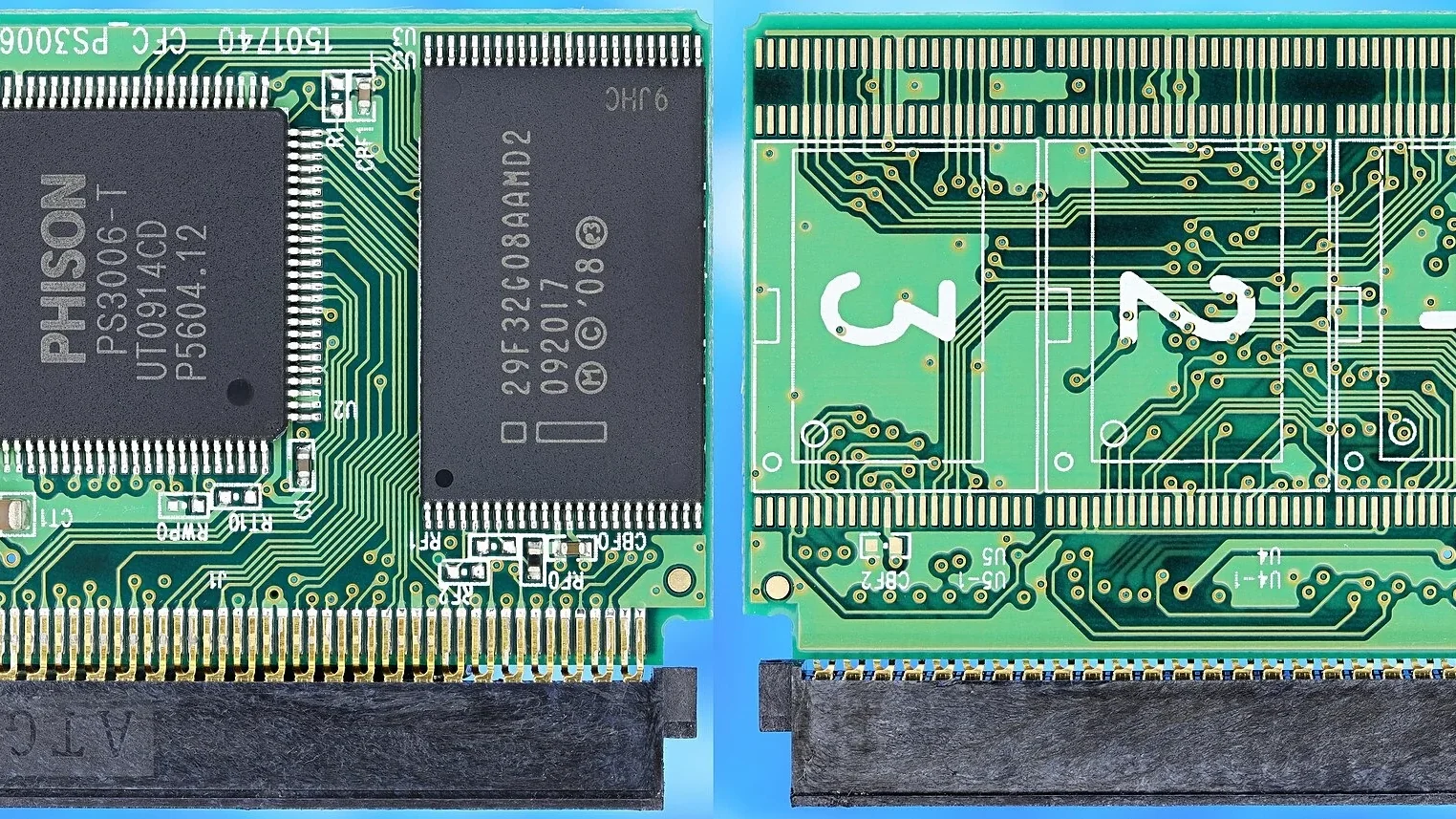
Phison SSD NPU: 64GB Memory, 130 GB/s, No Price
Phison SSD NPU shown at SC26: 36,800 DMIPS, 64GB at 130 GB/s, 10-100x less data movement claimed. No name, price or ship date yet.
Read moreThe top stories in the fields you follow, at 08:00 your time.
Phison SSD NPU shown at SC26: 36,800 DMIPS, 64GB at 130 GB/s, 10-100x less data movement claimed. No name, price or ship date yet.
Read moreAgenciesTreasury Secretary Scott Bessent said that no further restrictions on the sale of older Nvidia chips to China are needed following the Trump administration’s move earlier...
Read moreSK Ecoplant has launched AXen, a design-specialized AI platform, to automate design work. AXen generates spatial and equipment layout proposals using…
Read moreAmazon has been blocking third-party AI shopping agents such as Meta's Muse and OpenAI's Dots since September, with Delta Air Lines, Yelp, JPMorgan…
Read moreUS officials are seeking answers from semiconductor giant Nvidia following reports that advanced artificial intelligence (AI) chips may have reached China despite Washington's export controls.The reported development has raised fresh questions about the enforcement of US restrictions on advanced chip exports, potential loopholes in technology controls and China's access to powerful AI computing hardware.With Washington seeking clarification from Nvidia, the issue could add another layer of…
Read morePresident Donald Trump announced plans to penalise American companies that construct data centres outside the United States. This move, he said, aims to bolster the US artificial intelligence sector against Chinese competition and could complicate global AI infrastructure development.
Read moreClinical monitoring and wearable devices capture complementary physiological signals, but their partially overlapping modality coverage makes within-signal information and cross-modal relationships difficult to exploit jointly. We introduce LingSante-Pulse, a unified, general-purpose and flexible physiological representation framework that learns from these heterogeneous recordings. A shared, signal-conditioned encoder processes each physical channel independently and supports different numbers and combinations of signals for multimodal assessment and single-sensor inference. Pairwise cross-modal alignment, structured random-feature prediction (RFP) and masked waveform reconstruction jointly learn physiological relationships and preserve informative within-signal structure. Across 38 general physiological task configurations spanning PPG, ECG, EEG and EMG, the frozen encoder achieves the best dataset-balanced mean rank in each domain. In sleep assessment, multimodal staging on the HMC dataset and EEG-only staging on the Sleep-EDF dataset reach Macro-F1 scores of 0.7784 and 0.7941, respectively, while single-lead ECG apnea screening achieves an AUROC of 0.9183. Controlled…
High accuracy on mathematical benchmarks does not establish whether reasoning remains reliable as problem complexity increases. We examine how executable symbolic representations change accuracy scaling in large language models compared with natural-language reasoning. To address this limitation, we introduce the GSM Arithmetic Benchmark (GSM-AB), a controlled benchmark that independently varies operand digit length and operation count to probe numerical scale and compositional complexity. We find that executable representations can improve accuracy and slow its decline as complexity increases. Lean reduces average sensitivity to operand digit length at every tested model size. By contrast, slower degradation with increasing operation count emerges at the larger model sizes. A Python program-of-thought (Python-PoT) control shows a similar operation-axis pattern, suggesting that this finding is not specific to Lean. These findings show that reasoning representation shapes arithmetic accuracy scaling and support executable symbolic representations for more reliable reasoning on complex arithmetic tasks.
Sharing one low-rank adaptation (LoRA) update across pretrained models simplifies deployment. Composition methods typically combine updates from a common backbone, while cross-model transfer transforms updates for a target backbone. The conditions for sharing updates across backbones while preserving accuracy and distinguishing individual contributions remain unclear. Our idea is to use backbone-specific update directions as signatures of their training backbones. We derive a cross-backbone correlation bound from attention symmetries and equivariant LoRA learning under independent, uniform pretrained feature orientations. A local gradient-flow model explains positive mean correlation between independent runs on the same backbone and task. These patterns motivate cosine-based backbone identification and inner-product tests for registered-adapter reuse without coordinate alignment. Experiments on CLIP backbones show that shared sums achieve nearly the same mean accuracy as separate adapters. Cosine scores reliably identify source backbones across the evaluated tasks. Registered adapters remain detectable in sums of adapters from different backbones.
State-of-the-art multimodal sentiment analysis (MSA) models rely on large pretrained encoders, yet typically process every modality to its full depth, regardless of its computational cost or predictive contribution. This raises a fundamental question: how should limited computation be allocated across modalities to preserve predictive performance? We reveal a substantial mismatch between the computational cost of modality encoders and the predictive benefit of processing them more deeply, suggesting that different modalities require different encoding depths. However, enabling heterogeneous depths introduces a key challenge: representations extracted at different depths must still be effectively fused. To address this, we propose $\textbf{DepthMSA}$, a budget-aware framework that supports flexible modality depths within a single MSA model. Specifically, we introduce combinatorial anytime training, which supervises the fusion head across all cross-modal depth combinations using a single full-depth encoder pass. At inference, a training-free, cost-aware allocator selects the configuration with the lowest validation-calibrated error under a sample-specific FLOPs budget. On…
GPU acceleration has transformed electronic design automation (EDA), yet further improving expert-engineered GPU tools still demands substantial manual effort. Automating this work calls for coding agents that can trace bottlenecks across host and device code while preserving correctness and design quality. We introduce EDAGoat, to our knowledge the first EDA-aware GPU optimization agent for this task. Its optimization enhancement (OE) mode guides edits with four cross-project GPU optimization patterns. Its mandatory validation (MV) mode requires the agent to test the edited program against the EDA constraints its changes could affect. Our benchmark covers five GPU EDA projects across four task families and 55 circuit inputs, measuring complete-solve runtime and verifying the resulting designs. Each configuration runs three independent searches per project. A search qualifies only if its solver passes correctness and design-quality checks on all public and hidden inputs. With DeepSeek, generic prompting qualifies in 7 of 15 searches and OE in 6 of 15, despite a higher best speedup on four projects. Adding MV raises this to 13 of 15 and, on every project, exceeds both generic…
Modern software development relies on version control systems such as Git to track changes and facilitate collaboration. While commit messages are crucial for conveying developer intent, they do not affect program functionality; as a result, developers often lack motivation to…
Science agents increasingly package domain expertise as reusable skills that plan analyses, select tools, and execute workflows. This modularity creates a confidentiality risk: the interactions that deliver a skill's capability can also reveal the skill itself. We build an…
Task success is not a sufficient measure of safety for embodied artificial intelligence (AI), because robots may complete objectives while violating safety requirements. Existing evaluations often emphasize performance and robustness, but lack a systematic route from documented…
Feature analysis is a crucial step in medical image analysis, particularly in breast cancer classification. Traditional image analysis methods often struggle with optimal patterns along the diagonal axis, computational efficiency and feature buffer storage. Different classical…