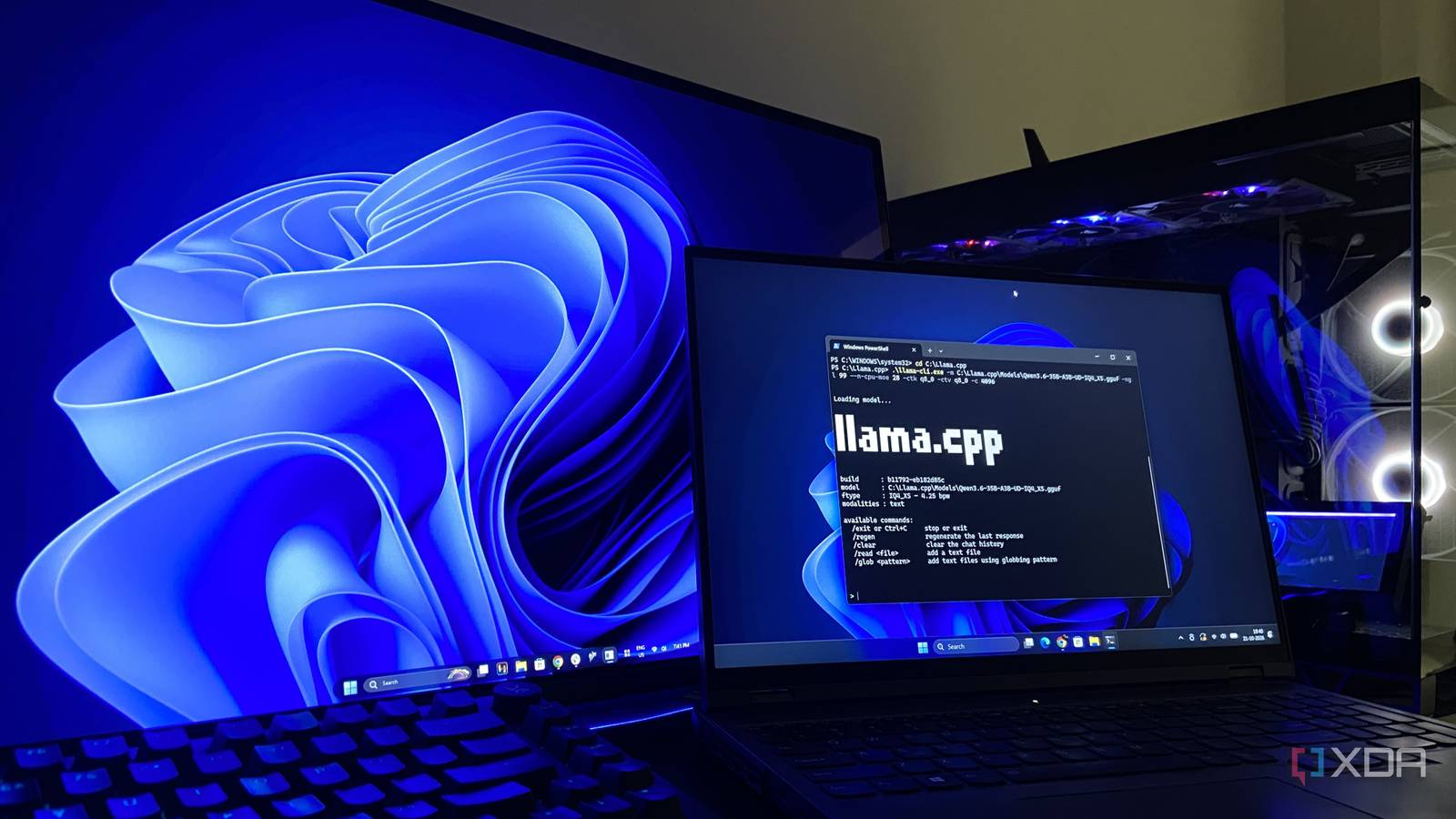
I changed one llama.cpp flag, and my 8GB laptop GPU now runs a 35B model faster than I can read
8GB of VRAM isn't the bottleneck, your settings probably are
Read moreThe top stories in the fields you follow, at 08:00 your time.
8GB of VRAM isn't the bottleneck, your settings probably are
Read moreMajor U.S. banks, including JPMorgan Chase, Bank of America, and Wells Fargo, have reportedly detected artificial intelligence agents accessing customer accounts without bank approval, with some attempting actions beyond users' instructions. The activity is prompting financial institutions to tighten security and restrict third-party AI tools.The findings, first reported by Axios...

Read moreDatadog Inc. (DDOG), a data organization software developer, has set its sights on expanding its security footprint with an attempt to acquire cloud security startup Upwind, as per an exclusive report by The Information.
Read moreCNBC's Kate Rooney discusses new Axios reporting detailing how major U.S. banks are detecting unauthorized third-party AI agents operating inside customer accounts.
Read moreLAS VEGAS — The proliferation of AI agents in banking and trading is presenting unresolved questions about reliability, liability and regulations, financial experts said at an Axios event. Why it matters: Introducing AI into commerce could streamline aspects of the consumer experience across banking,
Read moreReinforcement learning (RL) is an effective way to strengthen the long-context reasoning of large language models (LLMs), but it needs training data that are long, diverse, challenging, and verifiable. Human annotation of such data is expensive, naturally occurring data are too scarce to sustain RL, and existing synthesis methods depend on external corpora or stronger teacher models, which become harder to obtain as the trained models get stronger. Recently, RL from zero data, in which a model learns from tasks it proposes itself, has achieved excellent performance, but existing methods target short-context tasks. Therefore, we propose $\textbf{LongZero}$, a method that lets an LLM improve its own long-context reasoning without any external data. Instead of writing questions and answers over existing documents, LongZero first has the model synthesize the question and answer with its supporting evidence in a compact structured form, and only then separately expands the evidence into a long multi-document context. LongZero combines these self-written multi-hop reasoning tasks with self-written multi-round retrieval tasks and trains the model with GRPO. We evaluate LongZero on two…
Video world models predict future frames from past frames and actions. They serve as simulators in which agents train, plan or are evaluated, and that humans can control interactively. They generate in the latent space of a video autoencoder, whose compression sets their cost per frame and how long each action waits to take effect. Yet world models often reuse the autoencoders of text-to-video generators, built for offline generation with no agent waiting and, without their training data and code, not retrainable at another compression. We therefore ask how, where and how much a world model should compress. We build CADRE, an open family of causal diffusion representation autoencoders spanning multiple spatio-temporal compressions. Its members differ only in a small bottleneck on frozen features and share a diffusion decoder self-distilled to one or a few steps. We train the same world model on each autoencoder in two domains, manipulation and navigation, with two environments each. CADRE forms most of the latency-quality frontier, especially with a moving camera. Our study also leads to four findings. At strong compression, a diffusion decoder is sharper than perceptual…
Existing sequential recommenders usually allocate a fixed computational budget to every item in a user's interaction history, regardless of the item's contribution to the final prediction. We challenge this de facto design with two diagnostic findings. (1) Non-uniform computational need: items within the same sequence vary drastically in how much computation they require. Most converge after shallow processing while a critical minority only stabilizes at full depth. (2) Suboptimality of fixed allocation: given oracle access to the target item, a non-uniform depth assignment consistently outranks the fixed one, indicating that existing uniform computation both wastes capacity on already-converged items and sacrifices overall recommendation quality. These observations motivate a shift from fixed-depth computation to item-level adaptive reasoning. To this end, we propose LoopRec. LoopRec recursively applies a single weight-shared block and introduces a lightweight gate at each recursion boundary that makes a binary exit-or-continue decision for every item independently. Items whose representations have sufficiently matured exit early, while those requiring deeper reasoning continue…
Language models' abilities to interpret tasks and generate programs offer a promising basis for 3D spatial reasoning. Yet following spatial instructions in 3D scenes requires programs to construct geometric references that language leaves implicit. In this work, we introduce VoxProg, which formulates 3D object placement through voxel programming: a language model translates task interpretations into executable programs over local voxel views of scene surfaces. Because these views index surface geometry on regular grids with explicit coordinates and neighborhood relations, an evidence program can isolate task-relevant regions and boundaries directly from scene meshes, and a downstream pose program can measure the resulting geometry to compute a target $SE(3)$ pose. Visual and numerical feedback from execution lets the model inspect intermediate selections and candidate placements to iteratively revise its code. To evaluate open-ended placement across functional use, geometric fit, and contextual arrangements, we introduce the 71-task VoxProg-Bench benchmark along with an evaluation suite pairing perceptual Intent Alignment and 3D Physical Validity. Across VoxProg-Bench and…
Existing world models typically perceive a scene through current visual frame or a narrow history window. However, these observations may not reveal the physics properties that determine transition dynamics, such as an object's mass distribution, joint damping, or surface friction. Without calibrating these physics factors for world models, predictions tend to regress toward an empirical prior and induce severe drift in novel test scenes. To this end, we propose PhysiCalWorld, which calibrates action-conditioned world models to the instance-specific dynamics via in-context prompting, without fine-tuning or analytical physics modeling. Our method encodes an exploratory interaction clip collected within the test scene into a compact physics descriptor token, which grounds subsequent predictions in the scene's actual physical behavior. PhysiCalWorld is trained end-to-end with the latent prediction loss alone, without physics labels. At inference time, the descriptor token is extracted once and can be reused across rollouts with negligible compute overhead. We evaluate PhysiCalWorld across four environments covering diverse physics variations and show that it substantially improves…
We present GaussPDE, a framework that injects physically structured partial differential equation (PDE) dynamics into pretrained 3D Gaussian scenes without mesh extraction, voxelization, or retraining. Our key observation is that PDE rendering requires not only accurate…
Production customer-support systems often require LLMs to support multiple skills, such as intent classification, question answering, summarization, or tool-use decisions. A central deployment question is whether these skills should be handled by separate task-specialist models…
Enterprise data agents must preserve organization specific semantics, not just translate questions into queries. We present ChinaUnicom DataAgent (UniDataAgent), an ontology grounded system for reusable question-to-report analysis that separates semantic acquisition from online…
The Platonic Representation Hypothesis suggests that increasingly capable models converge toward shared representations. Recent work narrows this claim to shared local neighborhood relationships, finding that capacity-dependent trends in several global similarity measures…