DeepSeek-V4.1-Flash-1017 is a minor update to DeepSeek-V4.1-Flash, delivering substantial improvements across reasoning, coding, agentic tasks, and visual benchmarks. Alongside these gains, the model reduces task execution time and output length, enabling users to complete…
A series of consecutive cybersecurity incidents, ranging from critical vulnerabilities in PHP and Node.js to malware attacks infiltrating LiteLLM, has increased pressure on security teams worldwide.
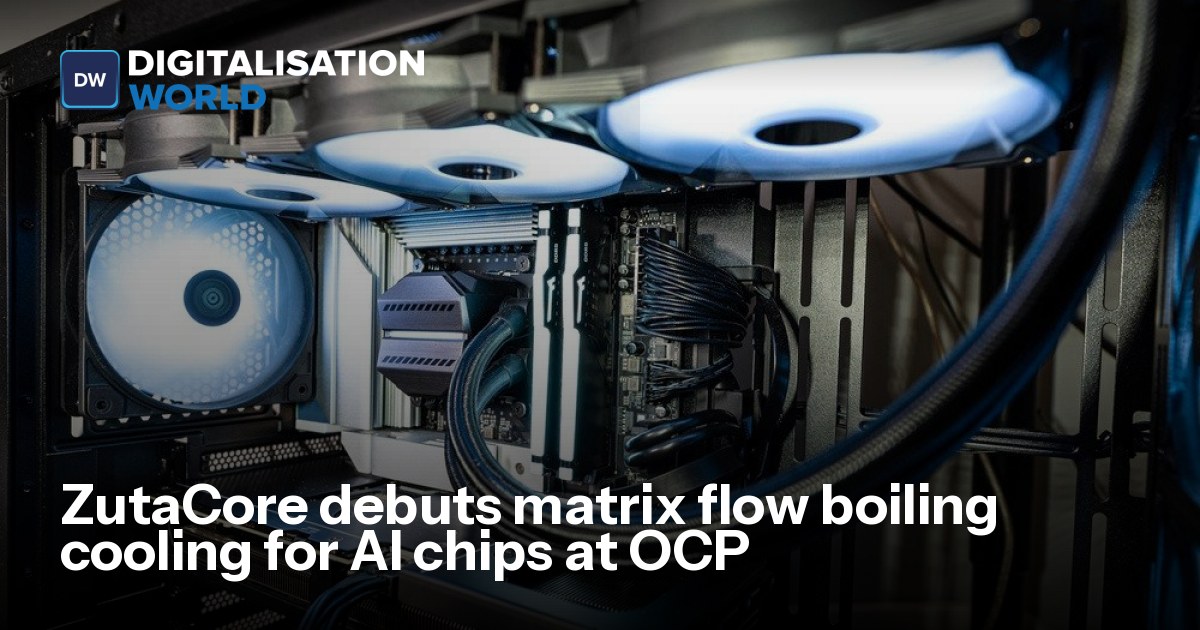
ZutaCore showed a new cooling architecture at OCP Global Summit 2026 that combines pool and flow boiling to keep hot spots on high-power AI chips at a stable...
TraceLink is introducing verifiable ai agents through its OPUS Brain platform, enabling businesses to automate recurring supply chain tasks using structured…
Text-to-speech models for Bantu tonal languages are challenged by a tonal system that is rooted in both the lexis (i.e., the inventory of words, stems, and affixes) and the grammar (i.e., morpho-syntax). To complicate matters, the standard writing systems of these languages…
Evaluating world models requires assessing both the quality of the worlds they generate and their consistency and responsiveness under exploration, interaction, and modification. We introduce HappyWorld-Bench, a comprehensive benchmark that evaluates whether generated worlds…
Astronomical maps made with different tracers are not expected to have identical morphology. Excitation, optical depth, chemistry, radiation, and ISM phase alter the response of a tracer, and the resulting differences can depend on both position and spatial scale. We propose…
Post-training often improves task performance but can degrade confidence calibration, leaving post-trained language models (PoLMs) more overconfident than their corresponding pretrained language models (PLMs). Because task-specific labeled calibration data can be costly or…