Will states set the rules for healthcare AI after the midterms?
States could take a larger role in regulating AI after Democrats won control of both chambers of Congress in the Nov. 3 midterm elections, according to
Read moreThe top stories in the fields you follow, at 08:00 your time.
States could take a larger role in regulating AI after Democrats won control of both chambers of Congress in the Nov. 3 midterm elections, according to
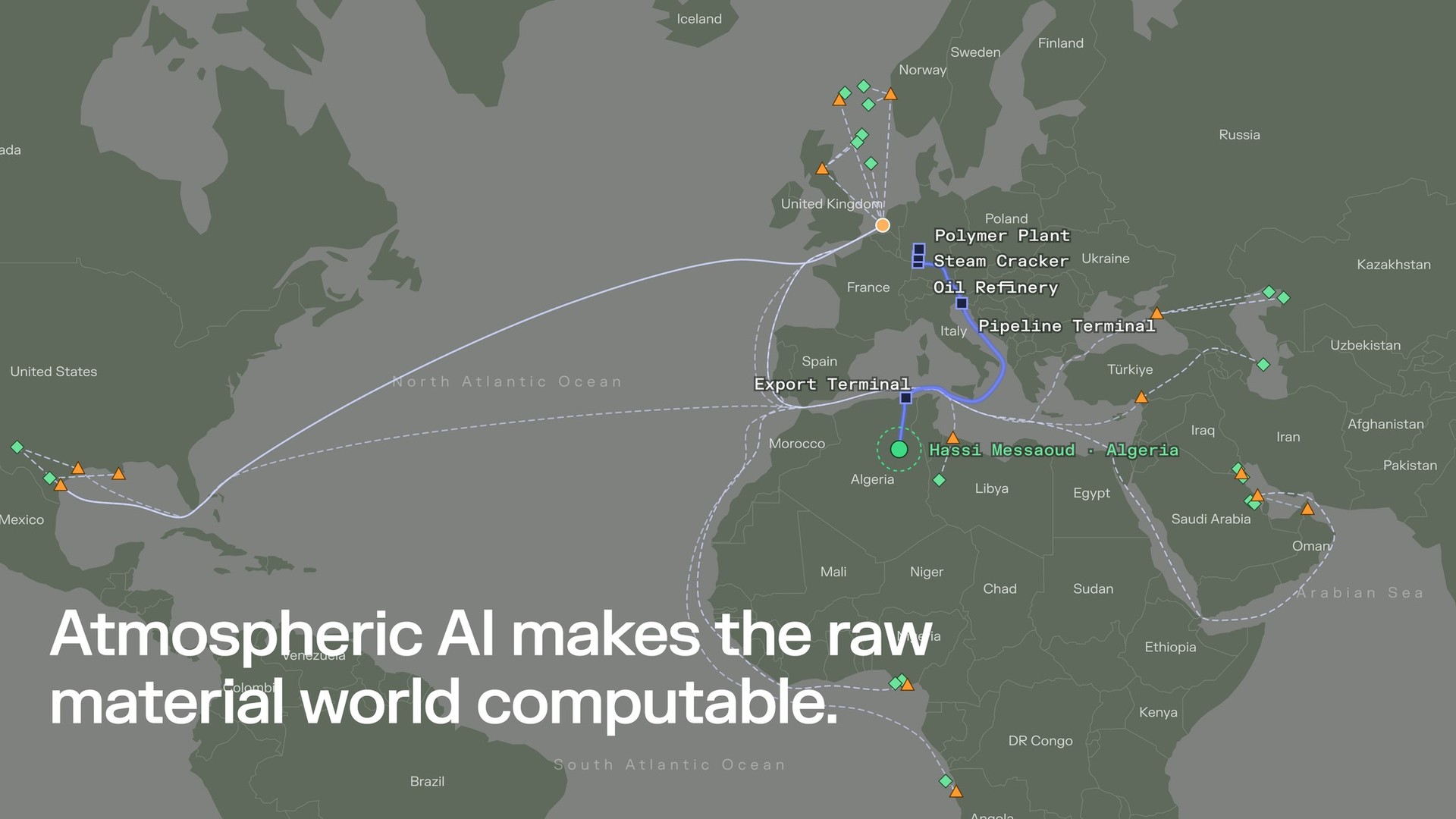
Read moreAtmospheric AI announced on November 5, 2026, that it had raised $10 million in seed funding led by DBL Partners to expand its computational models of raw-material supply chains. DBL Partners published its portfolio
Read moreAI industry PACs spent millions influencing the 2026 midterms, with mixed results. Political groups are already looking toward the next election cycle.
Read moreSentra says the past year brought more than 300% year-over-year growth, a surge it attributes to enterprises racing to deploy AI agents without fully understanding what those agents can access. The company's pitch centers on a platform that finds and classifies data across cloud,
Read moreIt got surprisingly close.
Read moreA shocking Democratic midterm blowout gives a boost to federal legislation that could regulate AI safety.
Read moreAdobe’s agentic teammate for customer experience orchestration, CX Enterprise Coworker, is now available within several leading artificial intelligence
Read moreProfessional services firms are turning to AI as Certinia expands its Veda agents to deliver context-aware, governed workflows at scale.
Read moreEnterprise software teams are giving artificial intelligence agents access to cloud environments despite widespread concerns about leaked credentials, misconfigurations, and costs, according to a new survey from LocalStack.
Read moreLearning a universal action representation from video requires modeling dynamics that are consistent across different executions of the same action yet invariant to changes in embodiment and appearance. Existing latent action models infer actions from visual transitions, but their representations often entangle the underlying action with irrelevant visual variations, limiting transfer across embodiments. We introduce DreamX, which repurposes a pretrained video diffusion model as a universal latent action learner. Our approach extracts compact latent actions from the video model's rich spatiotemporal features, compressing each latent video frame by $\boldsymbol{300\times}$ ($\boldsymbol{1{,}200 \rightarrow 4}$ tokens). In addition, by leveraging the video model's generative prior, these latent actions capture action-relevant dynamics disentangled from visual appearance. The resulting latent space serves as a shared action interface across embodiments (human and robot), environments, and action parameterizations. On LARY-Bench, DreamX achieves state-of-the-art performance among latent action models. Moreover, actions encoded in one setting remain effective in another: the latent…
For a decade, progress in artificial intelligence has been measured by how much a machine can do on its own. Large foundation models now write code and run multistep tasks, and personal agents act on a person's behalf. Yet people still forget what they once knew, miss what they are not looking at, fail to find the right words, and face hard choices without the benefit of their own history, because the machine that could help stands outside the situation. As AI moves into the physical world, attention has settled on one kind of intelligent individual, the embodied robot; we argue that the era of Physical AI holds a second kind of equal importance, the person augmented by AI. Alongside artificial general intelligence, which asks how intelligent a machine can be, stands AI-augmented human intelligence (AHI), which asks how much intelligence a machine can enable in a particular person. Realizing it calls for a new kind of system, a cognitive symbiont: a lifelong, embedded, real-time, private, low-friction, and proactive companion that senses what the person senses through external devices, keeps their context across years, models their situation and their mind, takes part in their…
Direct Nash Optimization (DNO) aligns a language model to a general preference function by approximating the Nash equilibrium of a two-player preference game. Its practical variant, DNO-Prct, iterates on-policy sampling, LLM-based rating of the samples together with a teacher's gold response, large-margin preference-pair selection and a DPO-style contrastive update. We re-implement DNO-Prct independently and study it on two open-weight instruct models, Llama 3.1 8B Instruct and Mistral 7B Instruct v0.1, with GPT-4o or a larger open-weight model of the same family as the annotator. On AlpacaEval 2.0 with GPT-4o as judge, three iterations raise the length-controlled (LC) win rate against GPT-4o from 31.7% to 45.3% for Llama and from 6.8% to 18.4% for Mistral, and the tuned 8B model scores above Llama 3.1 70B Instruct on every reported win rate. With same-family open-weight annotators, the runs retain 62% (Llama) and 82% (Mistral) of the LC gain achieved with GPT-4o as annotator, so the rating step does not require a proprietary model. In a separate ablation configuration, variants that remove the gold responses, remove the data look-back, or accept only teacher-preferred pairs…
Inverse kinematics (IK) converts end-effector pose commands into joint motion, and many vision-language-action (VLA) policies rely on it to act on a given arm and to transfer across embodiments. Precise IK remains laborious: redundancy and singularities complicate the inverse mapping, execution depends on hand-tuned controllers, and training data on physical robots are costly to collect. We present PolicyIK, a goal-conditioned reinforcement learning policy for high-precision IK. It updates joint-position references from pose feedback and observes its accumulated reference relative to the measured joints, so it can retain the offset that the position controller needs at rest. Two-scale pose errors with an error-dependent action gain resolve millimeter residuals while preserving large motions. Progress and dwell rewards teach it to both reach the tolerance and stay within it. In simulation, a single attempt by the trained PPO policy keeps the mean errors over the final second within 1 mm and 0.2° on 93.5% of held-out tasks, and a deployment protocol raises success to 98.9%. When trained directly on a physical arm with an off-policy RL learner, PolicyIK achieves higher reaching and…
Imitation learning policies in robotics are trained on datasets collected through costly real-world teleoperation. Often, the data-collection process is unguided, relying on the teleoperator's intuition, resulting in data that contributes little to overall policy performance. Recent work has shown that curating such unguided datasets can substantially improve policy performance, but these approaches operate by filtering existing datasets after collection and therefore do not prevent the acquisition of uninformative data. In this work, we propose GUILD, a novel Guided Data Collection (GDC) method that actively reasons about which data should be collected to maximize downstream policy performance. We introduce an iterative framework that alternates between 1) task proposal and data collection and 2) data evaluation to close the loop. For task proposal, we leverage semantic priors from vision-language models to identify relevant environments, object configurations, and goals for data collection. However, since semantic relevance does not imply policy improvement, we perform data evaluation. By leveraging predictive data attribution we approximate how the collected trajectories…
Real-time voice assistants must reason over evolving requests, execute actions, and follow conversational rules. Qwen-Audio-3.1-Realtime brings these requirements together through Think, Act, and Speak and Coordinate. Think combines Core-Cocktail supervised fine-tuning with…
As people turn to generative AI for financial advice, these systems can personalize how they communicate and what they say. Whether these forms of personalization shape decisions differently remains unclear. We conducted a preregistered 2 x 2 between-subjects factorial…
When a language model reads an operation such as "Swap the contents of Box F and Box B", its forward pass writes keys and values for those tokens into the KV cache. Prior work on entity tracking establishes what models use: bindings are resolved at query time rather than stored…
Nitrogen dioxide (NO2) is a common air pollutant, released into the atmosphere through the incomplete burning of fossil fuels, and associated with respiratory and cardiovascular diseases in humans. Ambient NO2 concentrations are regulated through air-quality limits assessed…