A survey in Artificial Intelligence Review categorises narrative theory-driven large language model methods and finds generation tasks lag behind understanding tasks.
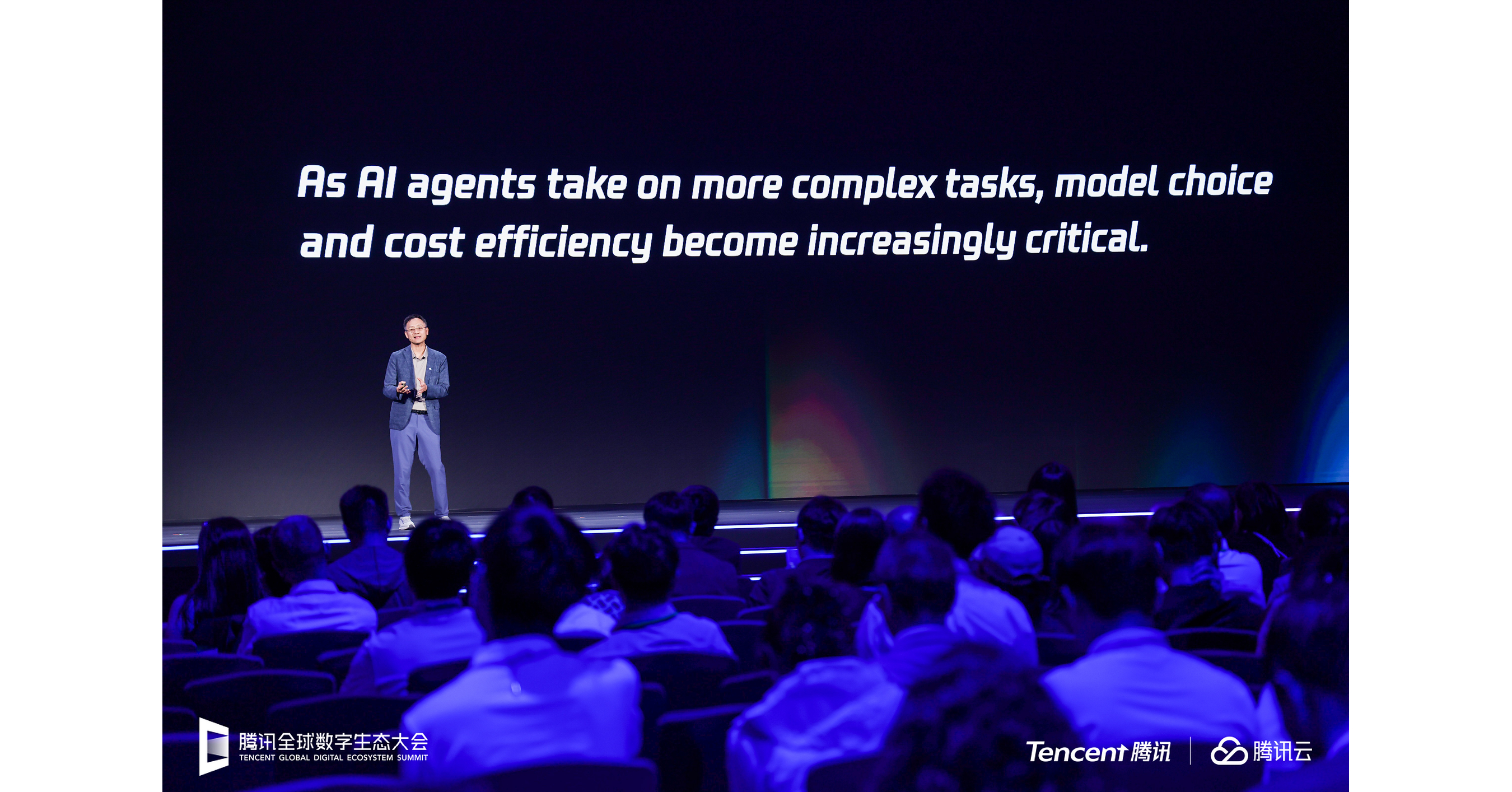
Tencent today unveiled the enterprise capabilities of its AI office productivity agent, WorkBuddy and previewed the upcoming general release of its Hy4 model and Hy4 Flash at the 2026 Tencent Global Digital Ecosystem Summit. Tencent Cloud's active overseas customer base has also doubled over the past year, while international demand for its AI products and services has grown by triple digits.
SHENZHEN, China, Oct. 30, 2026 /PRNewswire/ -- Tencent today unveiled the enterprise capabilities of its AI office productivity agent, WorkBuddy and previewed the upcoming general release of its Hy4 model and Hy4 Flash at the 2026 Tencent Global Digital ...
/PRNewswire/ -- Tencent today unveiled the enterprise capabilities of its AI office productivity agent, WorkBuddy and previewed the upcoming general release of...
Data attribution methods for Language Models (LMs) are typically evaluated using downstream tasks like fact retrieval. However, existing evaluations vary multiple dataset properties simultaneously, making it impossible to isolate exactly why an attribution algorithm fails. To diagnose these failures, we explore the design space of LLM data attribution, with a primary focus on evaluation. We introduce the Controlled Attribution Benchmark (CATT) for fact tracing, in which we fine-tune LLMs on entirely fictitious knowledge, providing unambiguous ground truth for attribution. This synthetic setup allows us to systematically alter one dataset configuration at a time, such as document redundancy and lexical distractors. With this configurable evaluation, we demonstrate that redundancy and distractors consistently degrade attribution performance. Rather than proposing a new estimator, we examine two design choices that are underexplored: the loss used to compute gradients and how per-token attribution scores are aggregated into a document score. We find that the true causal evidence within a training document is highly localized, but standard methods dilute this evidence into noise by…
In Nanbeige4.3, we take a foundational step toward pushing the boundaries of lightweight agents. Our strategy centers on building a high-capacity teacher agent first, which will subsequently anchor the distillation of advanced agentic capabilities into smaller models.
Ryan is joined by Charity Majors, co-founder and CTO at Honeycomb, for a conversation about applying the concept of immutable infrastructure to software development to treat code like cattle instead of pets, shifting the paradigm of system specifications to accommodate the…
Recent pre-trained foundation models provide rich multi-modal priors for downstream 3D vision tasks. However, the effectiveness of these representations in few-shot scenarios is limited by two fundamental challenges: High-dimensional features often contain substantial channel…
While Video Large Language Models (Video-LLMs) have recently demonstrated strong performance, reliably evaluating their fine-grained video understanding remains challenging. Existing benchmarks often rely on question answering or ground-truth caption matching, where models may…
Artificial Intelligence (AI) is becoming a fundamental design principle of future AI-native communication networks, enabling autonomous resource management, adaptive control, and zero-touch network operation. While current AI-native architectures increasingly embed intelligence…
Active reconstruction requires efficient active view selection to achieve high-quality reconstruction within limited onboard computational resources. Existing methods face challenges in adequately balancing visual and geometric quality with the computational efficiency required…