If a game developer uses generative AI to assist with roughly 10 lines of code—representing under 0.1% of the entire codebase—to resolve a critical bug during development, should that game be excluded from indie game award nominations?
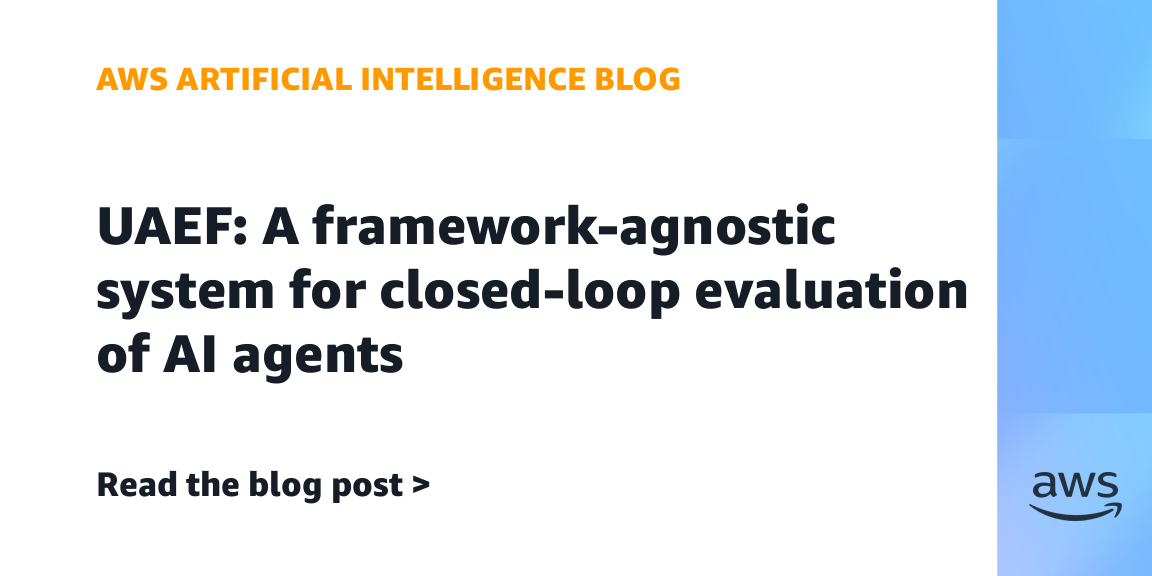
AWS on November 11, 2026, published a technical introduction to the Universal Agent Evaluation Framework (UAEF), an open-source system licensed under Apache-2.0 that evaluates AI agents using 36 built-in metrics across
Databricks launched native Genie plugins on November 11, 2026, for ChatGPT, Claude, Microsoft Copilot Cowork and Grok Bot. The integrations give all four agents governed access to business context held in Databricks,
The Universal Agent Evaluation Framework (UAEF) is a framework-agnostic system for evaluating AI agents. UAEF converts each framework's traces into one canonical format, scores them with 36 built-in metrics across 7 dimensions, and stores results so teams can compare agent versions and catch regressions.
Plurai announced the funding and launch on November 11, 2026, disclosing $13 million in seed funding and general availability for its AI-agent simulation platform. Team8 led the round as the company introduced a free
Compositional 3D scene reconstruction has recently been explored from two directions: agentic reasoning that provides semantic understanding of spatial relationships but lacks precise alignment with input images; and visual geometry foundation models that predict dense point…
Faithfully evaluating end-to-end driving policies in simulation requires observations that are not merely photo-realistic, but preserve the scene features a policy relies on to make decisions. Existing platforms, however, exhibit a sim-to-real visual gap that corrupts policy…
We study decentralized partially observable team decision problems with low-rank latent dynamics and unknown system models. The proposed framework combines team-theoretic equivalence with low-rank model representations to address cooperative decision-making in partially…
A multi-agent system can reduce latency on complex tasks by executing work concurrently. Several pioneering harness frameworks support multi-agent systems. However, the scalability of current multi-agent harnesses is often constrained by a central orchestrator's capacity to…