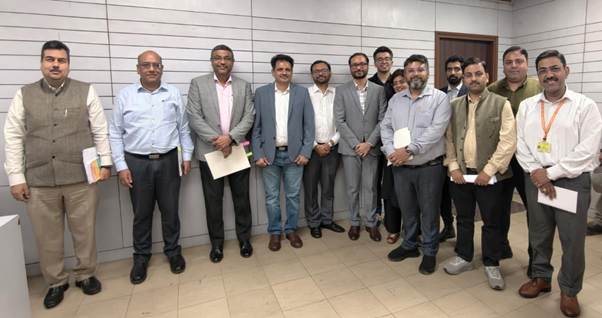
Vinod Bhat New Delhi: The IndiaAI Mission, under the Ministry of Electronics and Information Technology (MeitY), today released the indigenous foundation models EKA-1 and Dhīr (Dhīr 2B & Dhīr 5B) developed by Soket Labs Technology and Research Private Limited and ZenteiQ AiTech Innovations re
SemiAnalysis's Max Kan and Andrew Megalaa argue that most popular public AI benchmarks are broken, and that their new GDPx benchmark — built with 14 vetted
Y Combinator CEO Garry Tan spends up to ₹1.8 crore annually on AI tokens, with artificial intelligence agents managing parts of his daily life. These AI agents access extensive personal and professional data to assist him.
Anthropic released FlashProve, an open-source zkSNARK system that verifies large language model responses came from a specific set of weights. The tool proves inference on a 400-billion-parameter model at 110 tokens per second on a single H100.
Soket Labs and ZenteiQ have launched indigenous artificial intelligence foundation models under the IndiaAI Mission. This initiative marks another step in India's push to build homegrown AI capabilities.
Fourth-quarter revenue will be $17 billion, plus or minus 3%, the chipmaker said in a statement Tuesday. That easily topped the average analyst estimate of $16.3 billion, helping send the shares up about 7% in late trading.
CrowdStrike plans to make two acquisitions that will add artificial intelligence (AI) observability and automated AI security testing to the CrowdStrike
We study online learning with directed weakly observable feedback graphs and propose a Follow-the-Perturbed-Leader (FTPL) policy that achieves best-of-both-worlds guarantee with nearly linear expected time complexity. To preserve the simple structure of FTPL, we develop a novel graph-based loss estimator that combines forced exploration, conditional geometric resampling and adaptive learning rates with surrogate probabilities. Our policy achieves $\tilde{\mathcal{O}}(δ_*^{1/3} T^{2/3})$ regret for adversarial regimes as well as $\tilde{\mathcal{O}}(δ_* \log T / Δ_{\min}^2)$ regret for stochastic regimes, where $δ_*$ and $Δ$, respectively, denote the fractional weak domination number and the suboptimality gap. These results show that refined guarantees for problems with minimax regret of $Θ(T^{2/3})$ can be obtained through appropriately designed adaptive learning rates and loss estimators without sacrificing the simplicity of FTPL.
Idol turns one picture of an object into a 3D Gaussian splat. Give it a render, a generated image or a photo: it removes the background, frames the object and generates up to 1,048,576 Gaussians, written as a standard 3DGS .ply. It runs on consumer GPUs, using 7.2 GB of VRAM…