Anthropic Stock's $900 Billion Problem You Would Be Crazy To Ignore (NASDAQ:ANT)
Analyst rates Anthropic, PBC a Sell: 15.7x sales and $900.9 billion in leases could pressure margins if AI spending lacks durable corporate returns.
Read moreThe top stories in the fields you follow, at 08:00 your time.
Analyst rates Anthropic, PBC a Sell: 15.7x sales and $900.9 billion in leases could pressure margins if AI spending lacks durable corporate returns.
Read morePi Network news today: the Developer Console now connects AI coding agents to Pi apps, while a 200,000 USDT hackathon runs until January 5, 2027.
Read moreOut of a 100-page document, you only really need it to read a few pages. Such situations are common in work. Google announced new features for the Gemini API in its official blog dated November 23, 2026.
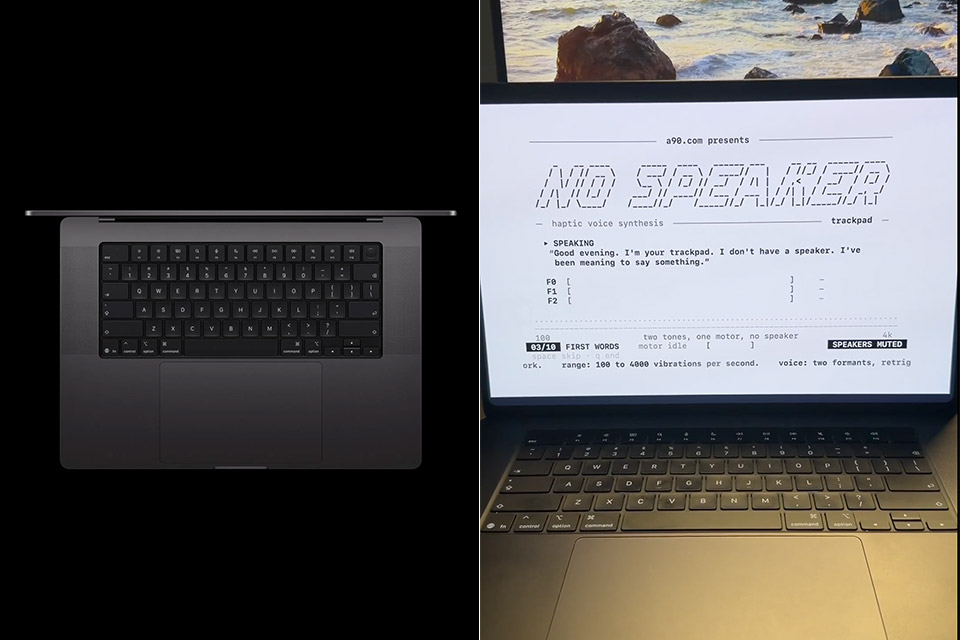
Read moreA MacBook trackpad contains no speaker of any kind. Instead, a small motor sits beneath the glass and delivers a quick tap so the surface feels as if it has clicked. Developer Cody Collier, working as os6, built a free tool called No Speaker that drives that same motor up to four thousand times each second. At those speeds the glass itself vibrates fast enough for the air around it to carry sound, and the laptop speakers stay completely silent. .twitter-tweet { margin: 0 !important; padding: 0…
Read moreThe 3 AI News Stories for Today is an article that summarizes three major AI stories from the previous day to this morning, designed to be read in 3 minutes.Today's three stories are: "GPT-6.2 arrives in the ChatGPT chat box,
Read moreBeam is a sparse Mixture-of-Experts (MoE) model with 501.3B total parameters and 23.4B active parameters, specifically built and optimized for coding, reasoning, and agentic workloads. Beam delivers frontier level reasoning, while requiring 3-4x less inference compute than many models of its class. Pretrained on 23.8T diverse, curated, high-quality tokens, Beam features a 1M-token context window achieved through a novel two-stage midtraining phase, built on verifiable, correctness-anchored data. Post-training leveraged a large-scale, fully asynchronous reinforcement learning (RL) campaign across 10.5K GB300 GPUs, generating over 100M rollouts over 4 weeks of training. We believe this is one of the largest scale RL runs conducted by any open lab to date. Across our evaluation suite, capabilities continued to improve as we increased RL compute, with no sign of a plateau. Supported by deep hardware-model co-design, FP8/NVFP4 quantization, and a 1.93B-parameter speculative decoding drafter (DFlash 2), Beam maximizes serving throughput with efficient, flexible deployment. Averaged across conversation turns and harm categories, Beam refuses or pivots on 88.9% of harmful requests while…
Video understanding, particularly with accompanying audio, remains a central challenge in multimodal intelligence. In this report, we introduce \textbf{WeMM-Video}, a family of Chinese-English bilingual omni-modal foundation models spanning 2B, 4B, 9B, and 35B-A3B variants. Centering on joint audio-visual perception and reasoning, WeMM-Video unifies text, image, audio, and video processing within a hybrid-thinking paradigm, seamlessly supporting both a non-thinking instruct mode for fast, direct responses and a thinking mode for explicit step-by-step reasoning. The models are trained on a large-scale multimodal corpus of approximately 1.2 trillion tokens through progressive pre-training and a multi-stage post-training pipeline incorporating multi-teacher OPD, anti-repetition MrDPO, and specialist RL. Evaluated across more than 120 benchmarks, WeMM-Video demonstrates superior performance in omni-modal video understanding and reasoning, while maintaining highly competitive capabilities across general audio, silent video, image, and text tasks. Specifically, in omni-modal video evaluations, our flagship WeMM-Video-35B-A3B establishes a new open-source state of the art, substantially…
Hy-MT3 is the third generation of the Hunyuan multilingual translation model family, including \textbf{Hy-MT3-1.8B}, \textbf{Hy-MT3-7B} and \textbf{Hy-MT3-30B-A3B (MoE)}. Compared with Hy-MT2, Hy-MT3 translates \textbf{more accurately, more completely and more faithfully to user constraints}: on real-world scenario data, the share of samples with mistranslations is reduced by \textbf{43\%}, omissions or additions by \textbf{74\%}, and instruction-following errors by \textbf{40\%}, while language coverage is expanded from \textbf{38 to 102} languages. With only 3B activated parameters, \textbf{Hy-MT3-30B-A3B achieves the best overall performance among all evaluated models in non-thinking mode}, including flagship models such as Qwen3.8-Max, Kimi-K3.1-Pro and DeepSeek-V4.1-Flash, and approaches the strongest closed-source thinking models such as GPT-6.1-Sol and Gemini-4-Argon, while surpassing models that consume \textbf{more than 30$\times$} its inference compute. Beyond general translation, Hy-MT3 is optimized for two industrial scenarios. For \textbf{game localization}, built with high-quality game-domain data and a professional evaluation system from the Honor of Kings team,…
We introduce Clover-35B-A3B-Preview (Clover), a mixture-of-experts diffusion language model with 35 billion total parameters and 3 billion activated parameters, supporting thinking-mode generation. Clover adapts Gated Delta Networks to block diffusion by combining recurrent memory of previously generated context with bidirectional softmax attention inside the current block. Historical memory readout competes with current-block tokens in a shared softmax, with learnable block-size calibration and a separate, zero-initialized right-context convolution branch. Clover leads the seven evaluated agent metrics, including 73.6 on SWE-bench Verified and 51.7 on Terminal-Bench 2.1. On internal agent workloads, it reaches a reported generation speed of 680 tokens/s using one NVIDIA GB300 GPU at BF16 precision and batch size one. We organize the evaluation around model quality, drafting and verification costs, and deployment under constrained memory. We also describe a decision-model variant that generates answers to related questions in one denoising pass. On an internal set of 500 groups, joint prediction raises question accuracy from 90.37% to 93.88% and all-correct group accuracy from…
We introduce Kumo Tabular, a family of open tabular foundation models for classification and regression, in three sizes: Kumo Tabular-S (27M parameters), Kumo Tabular-M (61M), and Kumo Tabular-L (214M). Pretrained only on artificial tables from the Kumo prior, they can make predictions on new tables without any training. In our approach, a table encoder compresses each row into an embedding, and an in-context learning transformer predicts the unlabeled rows from the labeled ones. Kumo Tabular introduces architectural innovations that improve both training stability and predictive performance, enabling the model to scale up to 150M cells on modern GPUs. Kumo Tabular-L ranks first on eight benchmarks: TabArena, TALENT, BeyondArena, ScoringBench, STRABLE, MulTaBench, RamanBench, and TabBench-Bio. These cover probabilistic regression, tables with over 1M rows or 100K columns, and tables with strings, text, or images. Accuracy improves with model size in all tested comparisons. All three sizes lie on the accuracy-speed frontiers of TabArena and BeyondArena. Kumo Tabular-L predicts faster than the runners-up, LimiX-2 on TabArena (36 times) and TabPFN-3.5 on BeyondArena (1.7 times).…
Many real-world decisions require prioritizing high-risk cases, such as clinicians prioritizing high-risk patients before lower-risk ones. Falling rule lists (FRLs), which are ordered if--then rules with monotonically decreasing risks, provide an interpretable framework for…
Obtaining the optimal action-value function in Markov decision processes is computationally intensive in large state--action spaces. In this study, we present statistically rigorous convergence results for a robust reinforcement learning algorithm warm-started by a…
Probabilistic inference is generally only tractable in low-treewidth graphical models, limiting its effective applicability in high-treewidth settings. Many existing methods improve efficiency by exploiting specific parametric structure, such as symmetries. However, they…
Decentralised federated learning replaces server aggregation with peer-to-peer model exchange, making collaborator selection a local decision under uncertainty. Fixed probe budgets waste effort on easy choices yet fall short when peers are hard to distinguish. We propose SAGE…