Pulse · xda-developers.com
xda-developers.com ·
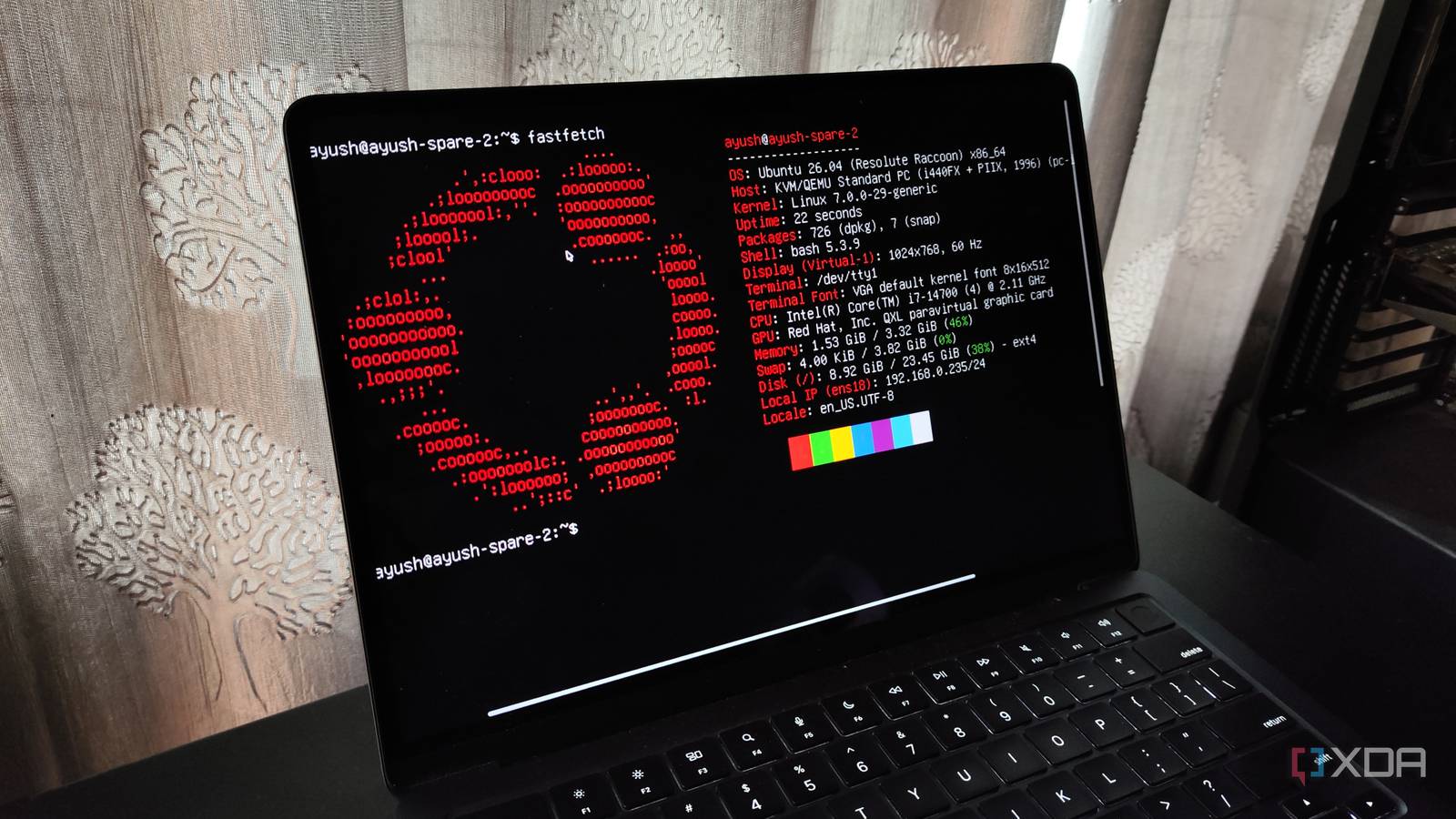
Ubuntu shows off an early version of its AI-powered launcher as it plans to integrate LLMs into the OS
The beginning of a new era.
Read moreThe top stories in the fields you follow, at 08:00 your time.
 Pulse · xda-developers.com
The beginning of a new era.
Read moreThe free, open-source beta keeps existing setups intact and charges for model usage. Its claimed savings depend on a comparison with using Opus 5.5 for every session.
Read more Pulse · thefastmode.com
IP Addresses Are the Quiet Part of the AI Economy. Here's What Changes in
Read more Pulse · siliconangle.com
Voice AI startup ElevenLabs reportedly seeking new funding at $33B valuation - SiliconANGLE
Read more Pulse · bioengineer.org
Researchers have created LLMPatients, an open-source platform that simulates virtual psychotherapy patients across an eleven-session curriculum using large language models, structured psychiatric
Read more Pulse · finance.biggo.com
The OpenClaw Foundation has released the results of ShellBench, a practical evaluation framework developed jointly with Hugging Face, Red Hat, and UC…
Read more Pulse · eu.36kr.com
As a product manager (PM), refining and optimizing the processes under your oversight is a core competency that directly drives team efficiency, reduces operational friction, and accelerates the delivery of high-value products. This question breaks down the structured, actionable workflow for PMs to revise their in-charge processes systematically: starting with collecting multi-stakeholder feedback from engineering, design, customer success and end users to identify unaddressed pain points,…
Read more Pulse · govinfosecurity.com
Small businesses want the benefits of AI but often lack the security, governance and expertise needed to adopt it safely. Pax8's Robert Belgrave says MSPs are
Read more Pulse · techgig.com
Microsoft Agent Framework introduces DevUI, allowing C# developers to run and test AI agents and workflows directly within ASP.NET Core web applications. This feature replaces traditional console app loops with an interactive chat page, showing tool calls and token counts.
Read moreBeam is a sparse Mixture-of-Experts (MoE) model with 501.3B total parameters and 23.4B active parameters, specifically built and optimized for coding, reasoning, and agentic workloads. Beam delivers frontier level reasoning, while requiring 3-4x less inference compute than many models of its class. Pretrained on 23.8T diverse, curated, high-quality tokens, Beam features a 1M-token context window achieved through a novel two-stage midtraining phase, built on verifiable, correctness-anchored data. Post-training leveraged a large-scale, fully asynchronous reinforcement learning (RL) campaign across 10.5K GB300 GPUs, generating over 100M rollouts over 4 weeks of training. We believe this is one of the largest scale RL runs conducted by any open lab to date. Across our evaluation suite, capabilities continued to improve as we increased RL compute, with no sign of a plateau. Supported by deep hardware-model co-design, FP8/NVFP4 quantization, and a 1.93B-parameter speculative decoding drafter (DFlash 2), Beam maximizes serving throughput with efficient, flexible deployment. Averaged across conversation turns and harm categories, Beam refuses or pivots on 88.9% of harmful requests while…
Video understanding, particularly with accompanying audio, remains a central challenge in multimodal intelligence. In this report, we introduce \textbf{WeMM-Video}, a family of Chinese-English bilingual omni-modal foundation models spanning 2B, 4B, 9B, and 35B-A3B variants. Centering on joint audio-visual perception and reasoning, WeMM-Video unifies text, image, audio, and video processing within a hybrid-thinking paradigm, seamlessly supporting both a non-thinking instruct mode for fast, direct responses and a thinking mode for explicit step-by-step reasoning. The models are trained on a large-scale multimodal corpus of approximately 1.2 trillion tokens through progressive pre-training and a multi-stage post-training pipeline incorporating multi-teacher OPD, anti-repetition MrDPO, and specialist RL. Evaluated across more than 120 benchmarks, WeMM-Video demonstrates superior performance in omni-modal video understanding and reasoning, while maintaining highly competitive capabilities across general audio, silent video, image, and text tasks. Specifically, in omni-modal video evaluations, our flagship WeMM-Video-35B-A3B establishes a new open-source state of the art, substantially…
AI-assisted coding ranges from fully agentic coding to inline code suggestions in the editor. Inline suggestions require predicting a developer's most likely next edit from an editing session. The next edit may lie at the cursor, in nearby lines, or farther away, and one editing intent can span several of these. The preceding system queries separate completion, nearby edit, and long-distance edit models, each with its own output format, in a fixed sequence; it thus cannot express intents spanning distant locations in one response, can require several sequential model calls per suggestion, and prioritizes completion even when a correction would serve better. We present a unified model that predicts all three edit types in one output space: a sequence of anchored diff patches specifying locations, deleted lines, and added lines. This representation permits multiple edits per response, so the client can serve later edits from a cache without further model calls. We train this model in two phases, first unifying next edit and long-distance edit prediction, then adding code completion. We synthesize multi-edit supervision from single-edit data via model pseudolabeling and edit history…
Hy-MT3 is the third generation of the Hunyuan multilingual translation model family, including \textbf{Hy-MT3-1.8B}, \textbf{Hy-MT3-7B} and \textbf{Hy-MT3-30B-A3B (MoE)}. Compared with Hy-MT2, Hy-MT3 translates \textbf{more accurately, more completely and more faithfully to user constraints}: on real-world scenario data, the share of samples with mistranslations is reduced by \textbf{43\%}, omissions or additions by \textbf{74\%}, and instruction-following errors by \textbf{40\%}, while language coverage is expanded from \textbf{38 to 102} languages. With only 3B activated parameters, \textbf{Hy-MT3-30B-A3B achieves the best overall performance among all evaluated models in non-thinking mode}, including flagship models such as Qwen3.8-Max, Kimi-K3.1-Pro and DeepSeek-V4.1-Flash, and approaches the strongest closed-source thinking models such as GPT-6.1-Sol and Gemini-4-Argon, while surpassing models that consume \textbf{more than 30$\times$} its inference compute. Beyond general translation, Hy-MT3 is optimized for two industrial scenarios. For \textbf{game localization}, built with high-quality game-domain data and a professional evaluation system from the Honor of Kings team,…
We present WeMM-Ecom, a family of multimodal large language models that deliver frontier e-commerce capabilities while achieving state-of-the-art general-purpose performance at their respective scales. The family spans five sizes, from a 0.8B dense model to a 35B mixture-of-experts model with 3B active parameters. Our training pipeline begins with two-stage continued pre-training that progressively raises the proportion of e-commerce data within a diverse multimodal data mixture, followed by hybrid-thinking post-training that combines on-policy distillation and reinforcement learning to support both non-thinking and thinking modes. For evaluation, we construct a comprehensive suite of 28 e-commerce benchmarks (23 in-house and five open-source) covering eight business scenarios and complement it with 64 public general-purpose benchmarks. On the e-commerce suite, WeMM-Ecom-35B-A3B surpasses substantially larger open-source flagship models, including Qwen3.8-Flash-Next, HY4, and DeepSeek-V4.1-Flash. On the general-purpose suite, every WeMM-Ecom model surpasses its similarly sized Qwen3.5 counterpart, with the lightweight variants (e.g., WeMM-Ecom-2B) showing clear advantages over…
The Abstraction and Reasoning Corpus and related benchmarks evaluate whether AI models can solve novel reasoning tasks, but often leave unclear whether success reflects inference of the intended underlying rule or reliance on shortcuts. We address this gap by studying test-time…
Neural morphological generation systems often achieve high aggregate accuracy on benchmark datasets, yet such performance can conceal systematic errors clustered in rare morphological subclasses. We present an orthography-aware diagnosis of Japanese past-tense verb inflection,…
This paper addresses the challenges of dynamic scene synthesis from sparse-view videos. Existing methods employ geometric priors, adaptive optimization, or density-control strategies to improve 4D Gaussian modeling under sparse observations. However, they cannot fundamentally…
Large language models (LLMs) are moving onto mobile devices for increasingly diverse workloads over text, images, video, and audio. These applications often require long contexts, making the Key-Value (KV) cache a dominant memory bottleneck because it grows linearly with…