Pulse · startupfortune.com

startupfortune.com ·
Mark Zuckerberg keeps coming out on top
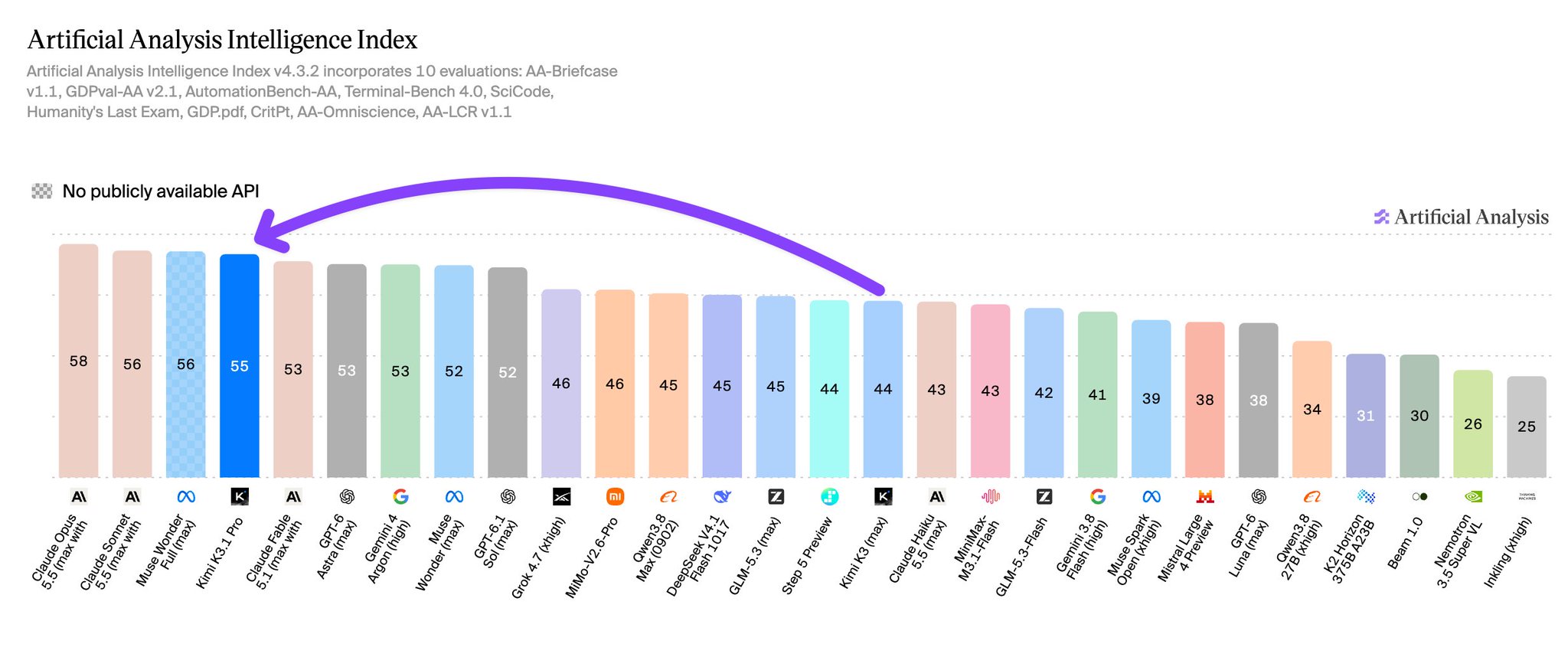
Moonshot AI's Kimi K3.1 Pro nearly matches Claude Opus 5.5 on coding benchmarks, with open weights landing November 4 amid rising enterprise demand.
Read moreThe top stories in the fields you follow, at 08:00 your time.
Moonshot AI's Kimi K3.1 Pro nearly matches Claude Opus 5.5 on coding benchmarks, with open weights landing November 4 amid rising enterprise demand.
Read moreFlint is Recursive’s mixture-of-experts language model for coding agents, with 39.8 billion total parameters and approximately 2.5 billion active per token. It is designed to investigate codebases, fix bugs, implement features, and write tests.
As streaming video generation advances, enabling real-time interaction with generated video is becoming increasingly important. We introduce StreamEval, a unified benchmark for interactive streaming video generation spanning five tasks: avatar dialogue, avatar performance,…
Spark-X2.6-4B retains exactly the same architecture as Spark-X2.5-4B, achieving its capability gains through improved post-training. It delivers substantial improvements in coding, agent, long-context, multilingual, reasoning, etc. These advances enable more capable and…
Uncensored release · Native FP8 (e4m3) + FP4 experts · 40-layer MoE · 1M context · Vision + video · Reasoning tiers · Tools
Multi-robot systems (MRS) offer significant advantages over single-robot platforms by enabling information sharing and coordination for different tasks in complex environments. However, reliable cooperation critically depends on inferring trust over both information sources and…
Language models are increasingly used to create synthetic survey samples, also called silicon samples. Decision models are a new class of language models that return a probability for each point of a rating scale instead of text. We ask whether these models, or the newest…
Foundation models need to support diverse inference budgets, yet training a separate model for each budget duplicates pretraining effort. Elastic models train several nested sub-networks inside one weight-shared supernet, but existing recipes face three obstacles: variable…
Deep research requires connecting multiple steps of search, reasoning, and computation, with intermediate findings guiding what to investigate next. As investigations grow, agents must maintain research state across model calls and check findings before errors propagate into…