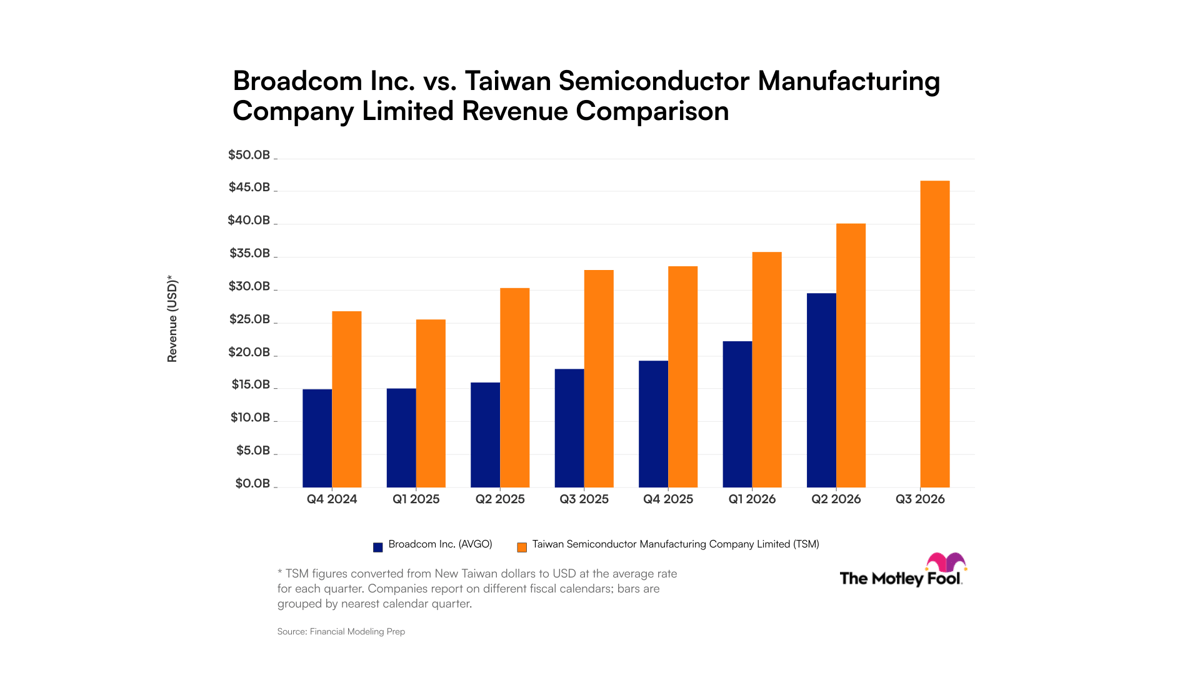
Broadcom and Taiwan Semiconductor are two of the biggest beneficiaries of the AI boom, but their revenue trends reveal a surprising difference in how quickly each business is growing.
While language models have become dramatically more capable, retrieval still largely relies on lexical matching or similarity in fixed embedding spaces. This creates a capability asymmetry: what the retriever fails to find, even the strongest generator cannot recover. We propose DecisionRAG, which brings the capabilities of pretrained language models to retrieval using decision models that jointly evaluate candidate branches in a single forward pass, without generating any tokens, and show that judging candidates in a shared context makes their relevance estimates comparable. Like a person browsing a library, DecisionRAG navigates the corpus's inherent structure from broad topics down to individual passages, deciding at each level which branches are worth exploring. Without task-specific training or a first-stage retriever, DecisionRAG outperforms dense retrieval with an 8B reranker by 13.8 R@1 points on MultiDoc2Dial and 17.4 Hit@1 points on Natural Questions. Across four benchmarks, including a corpus of 2.68 million Wikipedia paragraphs, retrieval takes just 0.7-1.8 seconds per query.
Flint is Recursive’s mixture-of-experts language model for coding agents, with 39.8 billion total parameters and approximately 2.5 billion active per token. It is designed to investigate codebases, fix bugs, implement features, and write tests.
AI planning studies how an agent can reach a goal by executing a sequence of actions. To plan correctly, the agent needs an action model describing when each action can be executed and how it changes the world. Constructing such models by hand requires domain expertise, and can…
Using large language models (LLMs) to simulate diverse human populations has the potential to transform many aspects of computational social science, yet many evaluations score the average response rather than the spread of opinion within real groups. Here, we develop a…
What is the least recurrent memory needed to reproduce a specified expert under partial observability? The instantaneous requirement is the conditional entropy of the expert's behavioral quotient, but recurrence must also preserve distinctions that future observations will not…