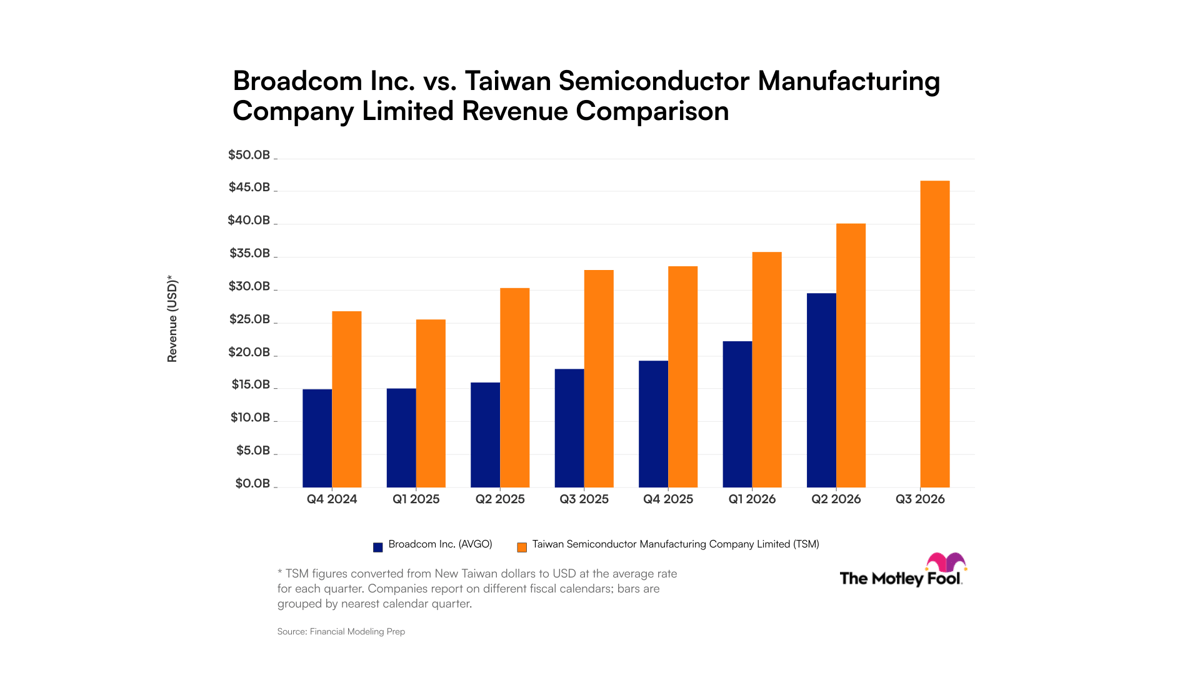
Broadcom and Taiwan Semiconductor are two of the biggest beneficiaries of the AI boom, but their revenue trends reveal a surprising difference in how quickly each business is growing.
While language models have become dramatically more capable, retrieval still largely relies on lexical matching or similarity in fixed embedding spaces. This creates a capability asymmetry: what the retriever fails to find, even the strongest generator cannot recover. We propose DecisionRAG, which brings the capabilities of pretrained language models to retrieval using decision models that jointly evaluate candidate branches in a single forward pass, without generating any tokens, and show that judging candidates in a shared context makes their relevance estimates comparable. Like a person browsing a library, DecisionRAG navigates the corpus's inherent structure from broad topics down to individual passages, deciding at each level which branches are worth exploring. Without task-specific training or a first-stage retriever, DecisionRAG outperforms dense retrieval with an 8B reranker by 13.8 R@1 points on MultiDoc2Dial and 17.4 Hit@1 points on Natural Questions. Across four benchmarks, including a corpus of 2.68 million Wikipedia paragraphs, retrieval takes just 0.7-1.8 seconds per query.
Flint is Recursive’s mixture-of-experts language model for coding agents, with 39.8 billion total parameters and approximately 2.5 billion active per token. It is designed to investigate codebases, fix bugs, implement features, and write tests.
Feed-forward 3D Gaussian Splatting now reconstructs renderable scenes from unposed, uncalibrated images. Yet, most models supervise only photometric consistency and predict Gaussians pixel by pixel, which leaves global structure fragile and ties primitive count to image…
Language models are appealing tools for research on the past. But to trust the evidence a model provides, researchers need to know whether its responses fit the period represented. Validation is challenging, because this is not a task living people ordinarily perform, and…
Modern prediction-driven decision systems often rely on black-box predictors, but a point forecast alone does not provide the uncertainty scale required for robust downstream decision-making. We build a score-calibrated robustness framework that converts any fixed point…
High-quality texture generation is essential for creating realistic and production-ready 3D assets. Recent multi-view diffusion methods have shown promising results for image-guided 3D texturing, but they are typically constrained to low operating resolutions such as 512 or…