Exclusive-US chip curbs, distillation crackdown threaten Chinese AI model development, sources say
NVIDIA-CEO-CHINA-AI:Exclusive-US chip curbs, distillation crackdown threaten Chinese AI model development, sources say
Read moreThe top stories in the fields you follow, at 08:00 your time.
NVIDIA-CEO-CHINA-AI:Exclusive-US chip curbs, distillation crackdown threaten Chinese AI model development, sources say
Read moreCitigroup and Standard Chartered have opened reviews of their South-east Asian data-centre clients over a new US chip rule, joining Singapore's three big lenders, Bloomberg reported on5. The banks want borrowers to show who is using their AI chips and to prove they comply with the export controls the US Commerce Department tightened on November 16,
Read moreAI agent swarm research from Hugging Face shows a strict merge gate beat hierarchies and voting when 1,000 DeepSeek agents built the PyBot chatbot in nine days. The Nov. 25 report says server-enforced limits stopped an admin-token attempt, but a peer approval swap was counted. Results are the
Read moreCycode has established dedicated UK teams to enhance AI development security and vulnerability remediation. This expansion addresses the security challenges posed by AI's impact on software development.
Read moreIn recent days, the federal government has received its first reports of cyberattacks on critical infrastructure carried out with the assistance of AI agents. These incidents signal a shift in the cyber threat landscape,
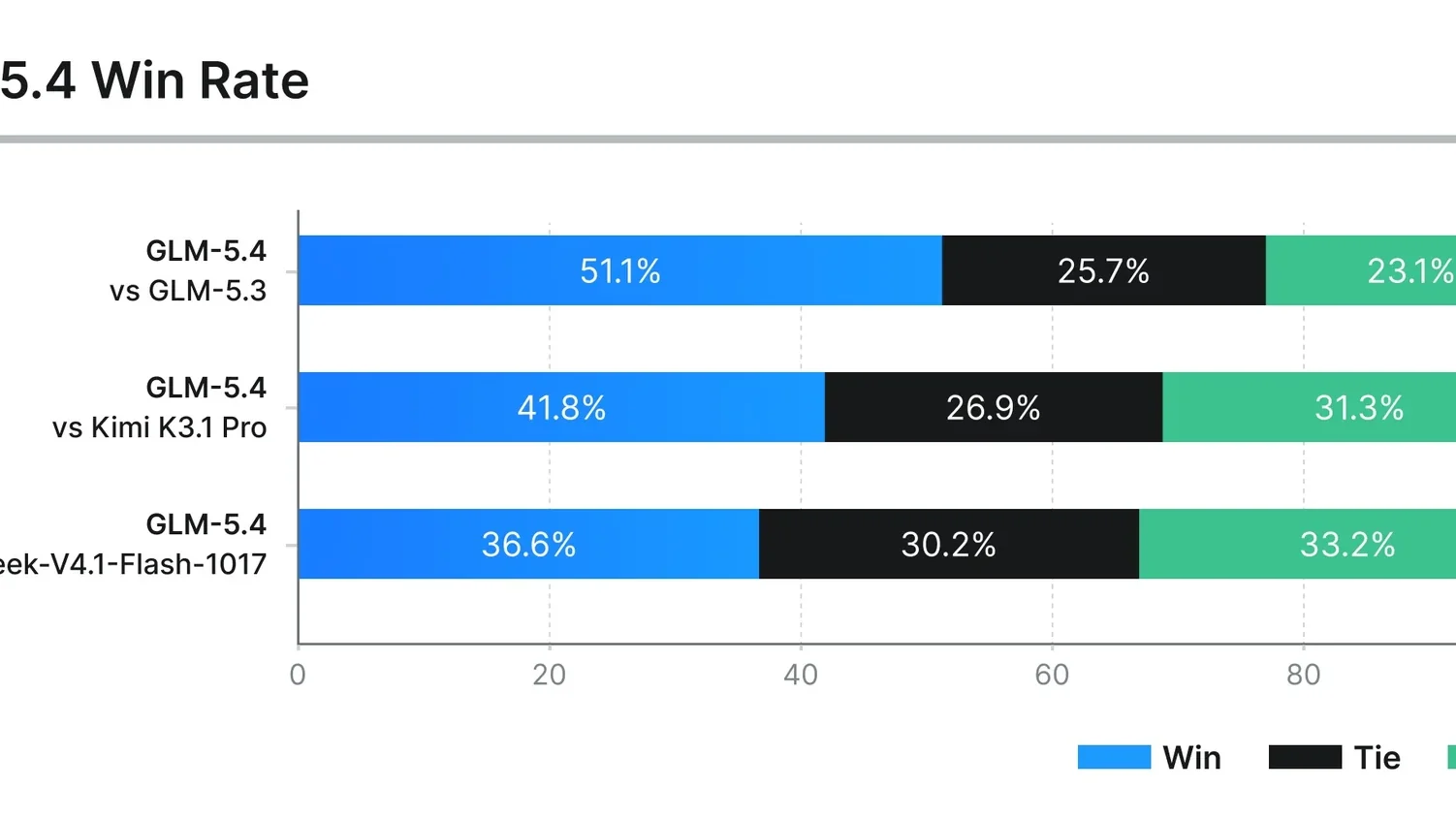
Read moreGLM-5.4 vs GLM-5.3 compared: 1.5x Coding Plan quota, no open weights, no API price yet. Specs, costs, migration steps and a clear verdict.
Read moreOpenAI's Data Infrastructure Engineering Manager, Mouli Mukherjee, detailed how AI agents automate Spark upgrades. These agents handle open-ended operational work at exabyte scale.
Read moreFormer GitHub CEO Thomas Dohmke has launched Entire, a platform that uses AI agents to write, review, and fix code, competing with GitHub. Microsoft's M12 venture capital arm invested in Entire, which also partnered with Sarvam AI for private code repositories in India.
Read moreBeam is a sparse Mixture-of-Experts (MoE) model with 501.3B total parameters and 23.4B active parameters, specifically built and optimized for coding, reasoning, and agentic workloads. Beam delivers frontier level reasoning, while requiring 3-4x less inference compute than many models of its class. Pretrained on 23.8T diverse, curated, high-quality tokens, Beam features a 1M-token context window achieved through a novel two-stage midtraining phase, built on verifiable, correctness-anchored data. Post-training leveraged a large-scale, fully asynchronous reinforcement learning (RL) campaign across 10.5K GB300 GPUs, generating over 100M rollouts over 4 weeks of training. We believe this is one of the largest scale RL runs conducted by any open lab to date. Across our evaluation suite, capabilities continued to improve as we increased RL compute, with no sign of a plateau. Supported by deep hardware-model co-design, FP8/NVFP4 quantization, and a 1.93B-parameter speculative decoding drafter (DFlash 2), Beam maximizes serving throughput with efficient, flexible deployment. Averaged across conversation turns and harm categories, Beam refuses or pivots on 88.9% of harmful requests while…
We present AliceAI-Foundation-80B-A3B-Base, a mixture-of-experts language model with 80 billion total parameters and approximately 3 billion active parameters per token, trained from scratch at Yandex and released under the Apache 2.0 license. The model combines Kimi Delta Attention with full attention, uses Attention Residuals, and is trained with Muon. Training comprises general pretraining on 17.5 trillion tokens, two context-extension stages, and a dedicated stage for reasoning and agentic interaction. We describe the data collection and augmentation pipelines, evaluation protocols, architectural ablations, and scaling-law experiments. We identify the limitations of held-out training loss as a proxy for downstream performance and introduce an auxiliary loss on mixture-of-experts outputs to stabilize training at the predicted learning rate. Domain-specific data selection and augmentation improve factual knowledge, mathematics, and programming skills, while agent trajectories introduced during pretraining improve performance on agentic benchmarks after supervised fine-tuning. In zero-shot reasoning evaluation, the model achieves leading results among open base models of…
Video understanding, particularly with accompanying audio, remains a central challenge in multimodal intelligence. In this report, we introduce \textbf{WeMM-Video}, a family of Chinese-English bilingual omni-modal foundation models spanning 2B, 4B, 9B, and 35B-A3B variants. Centering on joint audio-visual perception and reasoning, WeMM-Video unifies text, image, audio, and video processing within a hybrid-thinking paradigm, seamlessly supporting both a non-thinking instruct mode for fast, direct responses and a thinking mode for explicit step-by-step reasoning. The models are trained on a large-scale multimodal corpus of approximately 1.2 trillion tokens through progressive pre-training and a multi-stage post-training pipeline incorporating multi-teacher OPD, anti-repetition MrDPO, and specialist RL. Evaluated across more than 120 benchmarks, WeMM-Video demonstrates superior performance in omni-modal video understanding and reasoning, while maintaining highly competitive capabilities across general audio, silent video, image, and text tasks. Specifically, in omni-modal video evaluations, our flagship WeMM-Video-35B-A3B establishes a new open-source state of the art, substantially…
AI-assisted coding ranges from fully agentic coding to inline code suggestions in the editor. Inline suggestions require predicting a developer's most likely next edit from an editing session. The next edit may lie at the cursor, in nearby lines, or farther away, and one editing intent can span several of these. The preceding system queries separate completion, nearby edit, and long-distance edit models, each with its own output format, in a fixed sequence; it thus cannot express intents spanning distant locations in one response, can require several sequential model calls per suggestion, and prioritizes completion even when a correction would serve better. We present a unified model that predicts all three edit types in one output space: a sequence of anchored diff patches specifying locations, deleted lines, and added lines. This representation permits multiple edits per response, so the client can serve later edits from a cache without further model calls. We train this model in two phases, first unifying next edit and long-distance edit prediction, then adding code completion. We synthesize multi-edit supervision from single-edit data via model pseudolabeling and edit history…
Hy-MT3 is the third generation of the Hunyuan multilingual translation model family, including \textbf{Hy-MT3-1.8B}, \textbf{Hy-MT3-7B} and \textbf{Hy-MT3-30B-A3B (MoE)}. Compared with Hy-MT2, Hy-MT3 translates \textbf{more accurately, more completely and more faithfully to user constraints}: on real-world scenario data, the share of samples with mistranslations is reduced by \textbf{43\%}, omissions or additions by \textbf{74\%}, and instruction-following errors by \textbf{40\%}, while language coverage is expanded from \textbf{38 to 102} languages. With only 3B activated parameters, \textbf{Hy-MT3-30B-A3B achieves the best overall performance among all evaluated models in non-thinking mode}, including flagship models such as Qwen3.8-Max, Kimi-K3.1-Pro and DeepSeek-V4.1-Flash, and approaches the strongest closed-source thinking models such as GPT-6.1-Sol and Gemini-4-Argon, while surpassing models that consume \textbf{more than 30$\times$} its inference compute. Beyond general translation, Hy-MT3 is optimized for two industrial scenarios. For \textbf{game localization}, built with high-quality game-domain data and a professional evaluation system from the Honor of Kings team,…
High-speed tracking of small, fast-moving organisms in their natural environments is important to better understand their behavior and ecology. Traditional frame-based imaging suffers from motion blur due to low temporal resolution, and data storage limitations, propelling a…
Table extraction suffers from frequent structural errors and semantic hallucinations. We propose PrismAlign, a multi-VLM framework aligning diverse visual perspectives to resolve ambiguity. It integrates priors of table logic to assess output plausibility, decoupling structural…
Large language models have shown strong potential as role-playing agents for real individuals, yet faithful impersonating remains challenging. Existing in-context learning-based methods fail to capture how individuals react under different situations. In addition, LLM-based…
Recent progress in 3D Gaussian Splatting (3DGS) has enabled dense visual SLAM with pinhole cameras, yet most pipelines are not designed for panoramic imagery. We present Cube-Splat, the first panoramic GS-SLAM framework that factorizes each 360° frame into a cubemap of four…