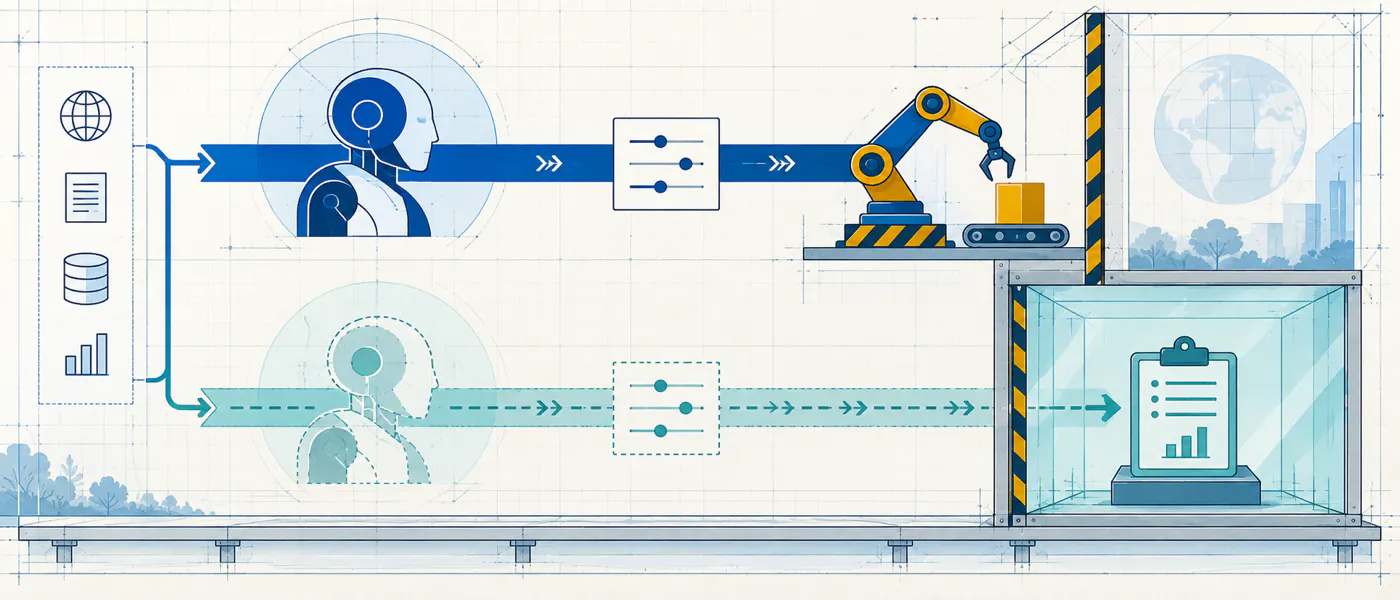
How to Shadow-Test an AI Agent Without Letting It Act Twice
Shadow testing can compare a candidate AI agent on real traffic—but only if proposals, policy decisions, and side effects are cleanly separated.
Read moreThe top stories in the fields you follow, at 08:00 your time.
As streaming video generation advances, enabling real-time interaction with generated video is becoming increasingly important. We introduce StreamEval, a unified benchmark for interactive streaming video generation spanning five tasks: avatar dialogue, avatar performance,…
Spark-X2.6-4B retains exactly the same architecture as Spark-X2.5-4B, achieving its capability gains through improved post-training. It delivers substantial improvements in coding, agent, long-context, multilingual, reasoning, etc. These advances enable more capable and…
Uncensored release · Native FP8 (e4m3) + FP4 experts · 40-layer MoE · 1M context · Vision + video · Reasoning tiers · Tools
Brain encoding models aim to predict neural responses to stimuli. The most widely used approach fits readouts from frozen pretrained backbones. Using neural data to train large models from scratch or fully fine-tune them after task-pretraining has proven difficult because…
Terminal agents have shown strong abilities in complex coding tasks. However, they often struggle to recover from errors during long-running execution (e.g., command errors, faulty implementations), eventually leading to task failures. To this end, we present ReTerm, a…
We introduce Fish Audio Drama 3, an open-source speech generation model that turns text into directed performances, built on a 35B-parameter mixture-of-experts backbone that activates 3B parameters per token. It clones voices from multiple references, follows natural-language…
Few-step distillation reduces the sampling cost of diffusion and flow models, but existing approaches often require auxiliary score models or specialized architectures. We show that simple on-policy velocity regression already provides a strong foundation for 4-NFE generation.…