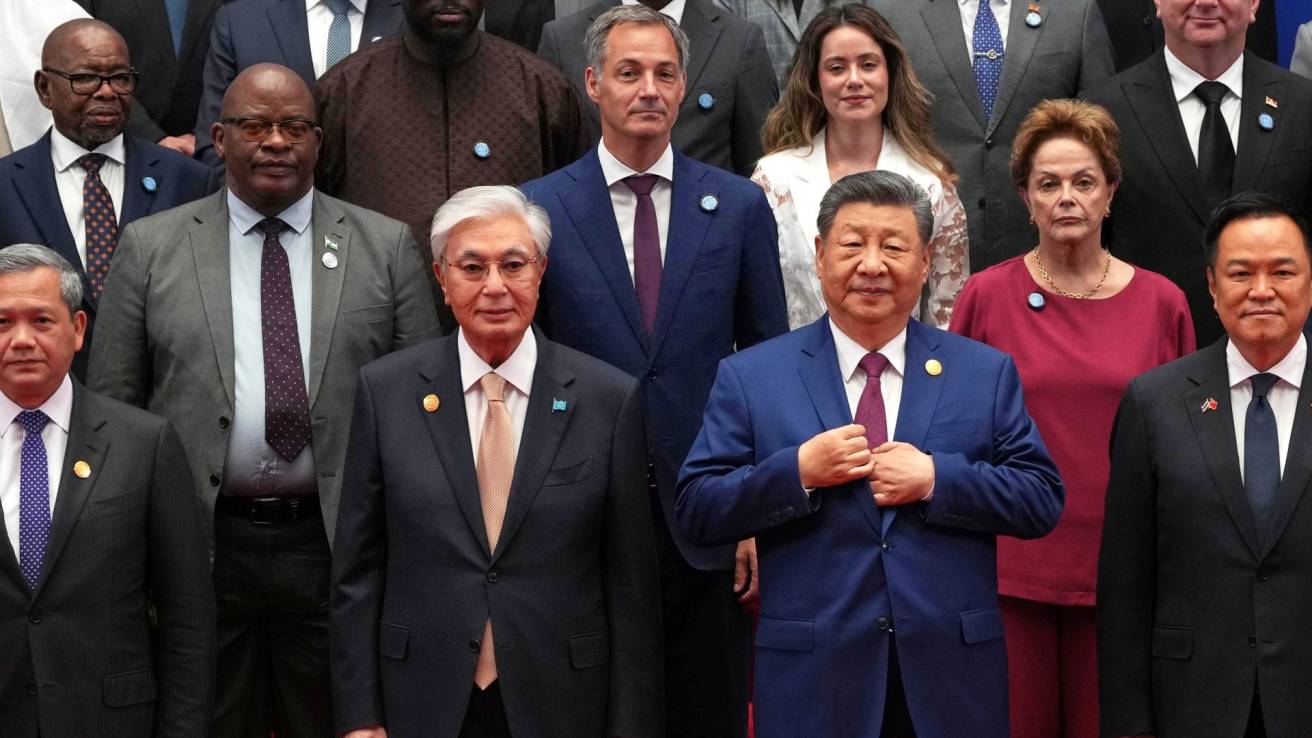
What China's AI advances mean for Australia's technology choices
Australia weighs AI infrastructure rules; China's response to US restrictions raises questions about our investments' value and dependencies.
Read moreThe top stories in the fields you follow, at 08:00 your time.

Australia weighs AI infrastructure rules; China's response to US restrictions raises questions about our investments' value and dependencies.
Read moreVercel explains Vercel Agent’s read-only baseline, plan approval, token scopes, provider credentials and active-plan checks for production work.
Read moreToday we are taking a look at ASRock's high-end Radeon AI inference card for workstations, the Creator Radeon AI Pro R9700. With 32GB of RAM and a $1700 price tag, the card is a highly affordable way
Read moreThe above button links to Coinbase. Yahoo Finance is not a broker-dealer or investment adviser and does not offer securities or cryptocurrencies for sale or facilitate trading. Coinbase pays us for certain activity generated through this link. Prices ...
Read moreApple’s new iPad mini has A20 Pro, but Siri AI beta access depends on software, language, region and age. Preorders start October 28.
Read moreFor investors mulling the Anthropic share offering, a 10% chance of extinction may be a 90% win for your portfolio.
Read moreA hiring mindset forces businesses to define the role, set boundaries and measure results before deploying an AI agent.
Read moreOracle unveils AI agents to speed cloud software implementation, automate configuration and testing, and reduce deployment complexity for businesses.
Read moreIn Lewis Carroll's "Alice Through the Looking Glass," the eponymous heroine encounters the Red Queen, who involves her in a frantic race. In this curious country, Alice learns, you have to run as fast as you possibly can only to remain in the same place.
Read moreThis article argues that instruction-fine-tuned language models should be understood as implementing a genre, what is proposed as the instructional-conversational genre. This genre is an amalgamation of discursive language from prior conversations between generative models and humans recursively run through these massive neural networks. It is instantiated in applications through instruction fine-tuning, the inclusion of a pretext known as a system prompt, and the formalization of inputs in mark-up languages characterized by the use of special tokens and role assignment in turntaking structures.
Training generalizable embodied agents requires realistic, varied, and simulation-ready indoor environments. Language-guided methods support semantic planning and object-level reasoning, but precise spatial grounding remains difficult. Visual generative models offer rich priors over plausible arrangements, yet their outputs require geometric reasoning to become physically valid 3D scenes. We introduce SceneBloom, an agentic framework that combines visual layout sampling with contract-guided 3D compilation. A hierarchical sampler uses diffusion priors to generate furniture arrangements within functional zones. A compiler then uses relations extracted from each proposal to guide geometric fitting and local pose correction. Across five room types, SceneBloom attains the highest visual quality and physical stability among the compared methods and is the only method with no detected mesh collisions and out-of-bounds objects. Its layouts are also closer to the distribution of real rooms than those of all compared baselines. Object navigation policies trained in these realistic scenes achieve a higher success rate in held-out real scans than those trained on an equal number of real…
Actions that condition world models are highly heterogeneous, and thus existing action-conditioned world models are typically built for individual action types, fragmenting already limited action-annotated data across separate models. We introduce UniAction, a unified action-conditioning framework that represents any action as a sparse set of action elements, each with a discrete semantic identity and a continuous spatiotemporal grounding coordinate. By mapping these coordinates directly into the pretrained video model's native positional space, UniAction allows heterogeneous actions to condition a shared world model within the same spatiotemporal structure. We further introduce cardinality-calibrated attention to address the bias from differing action representation granularities. We evaluate UniAction on four representative action forms: force, camera control, hand pose, and robot pose. UniAction outperforms conditioning alternatives in action following, and a single jointly trained model surpasses the action-specific experts, showing that heterogeneous action data benefit from unified model and joint training.
To estimate correspondences across images, existing approaches match either sparse interest points, which is highly efficient but limited by repeatability, or dense pixel grids, which is robust but expensive. Furthermore, these approaches are trained with only matching pairs and thus often fail to reject unrelated pairs that exhibit visual symmetries, which is equally important in applications like Structure-from-Motion (SfM). We bridge these gaps by introducing FlexGlue, a neural network for asymmetric sparse-to-dense matching and disambiguation. Given two images and coordinates of points in the first image, FlexGlue estimates the coordinates of the corresponding points in the second image while simultaneously rejecting the pair if non-matching. By searching for a limited set of correspondences among dense pixels, our approach is both fast and effective at both matching and disambiguation: it combines the sub-pixel accuracy of dense matching with the speed of sparse matching, while rejecting incorrect pairs with high precision. Experiments on multiple datasets show that FlexGlue pushes the Pareto frontier in relative pose estimation and significantly outperforms existing…
Robust reinforcement learning (RL) is critical for reliable real-world deployment, where policies may fail under diverse shifts and disruptions. Existing robust RL algorithms offer a rich set of mechanisms and principles, yet two major barriers limit their broader potential: limited algorithm reusability and an unclear empirical capability boundary. We introduce RobustRLlib, an algorithm-centric library and benchmark that addresses both challenges. It integrates 17 representative robust online, offline, and safe RL algorithms under a unified interface for substantially improved reusability, together with an enhanced evaluation platform spanning diverse real-world shifts and advanced humanoid and vision-language-action tasks. Systematic evaluation over 273 perturbation configurations provides an up-to-date capability map of current robust RL algorithms, revealing where they remain effective and where substantial robustness gaps persist. As an open-source, user-friendly platform, RobustRLlib offers a reproducible and extensible codebase for applying existing methods to new problems and developing new robust RL algorithms.
Traditionally, the reliability of news publishers is assessed by expert organisations that evaluate editorial practices, transparency and factual standards at source. When this process is translated into a computational approach, the problem is often formulated at the level of…
Although text-to-image models can accurately depict subjects and scenes, creators still struggle to specify the fine-grained emotions an image should convey without rewriting its content description. Natural language can suggest emotions, but it offers no control scale with…
Building strong chart-to-code systems increasingly relies on reinforcement learning, whose effectiveness depends critically on the quality of the reward signal. Large Multimodal Models (LMMs) play a natural critical role in jointly assessing chart visual appearance and task…
The Platonic Representation Hypothesis (PRH) claims that independently trained models converge on a shared statistical model of reality, yet recent work finds only weak pointwise similarity between models. In this paper, we show that what models share is not the location of…