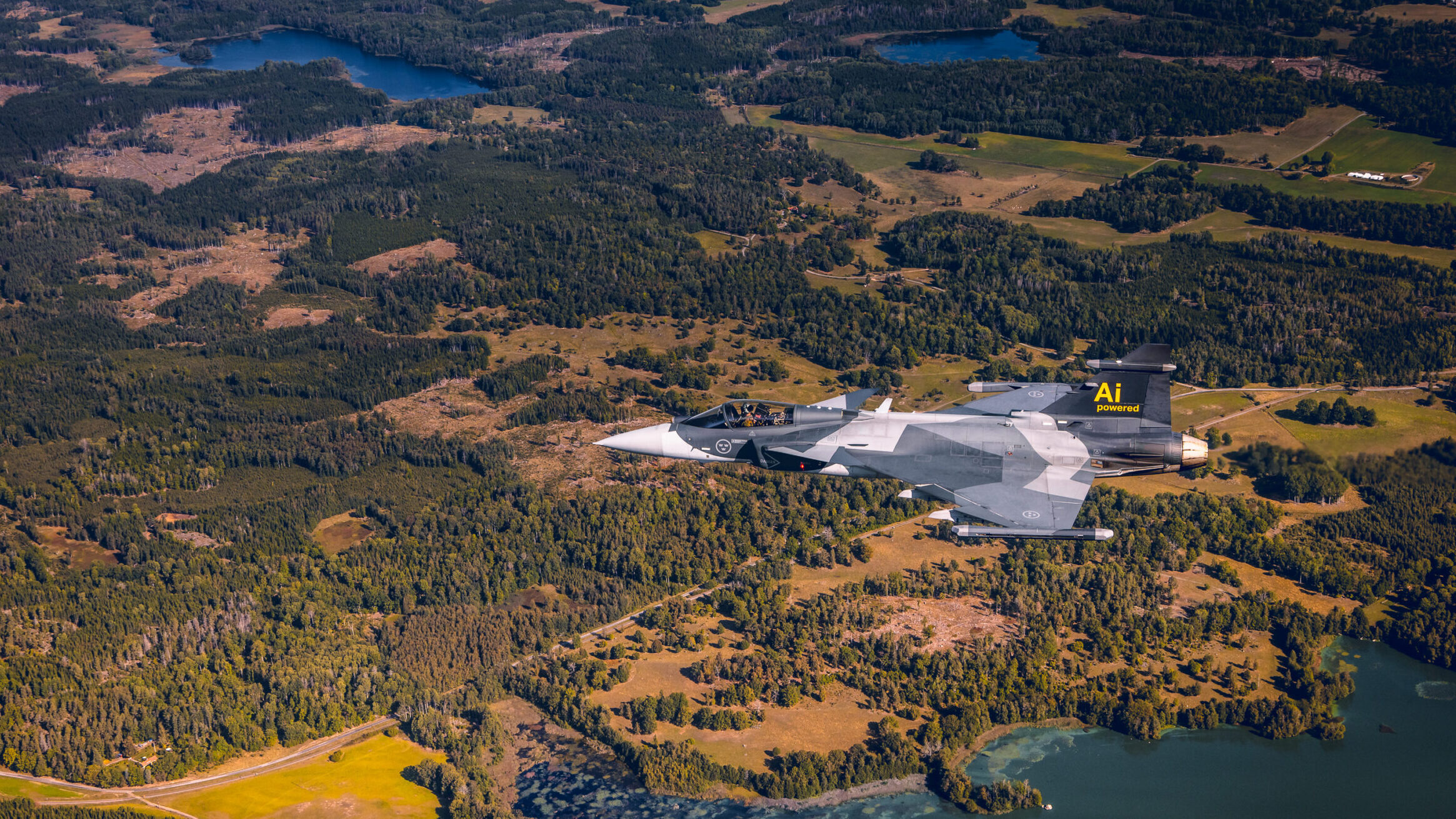
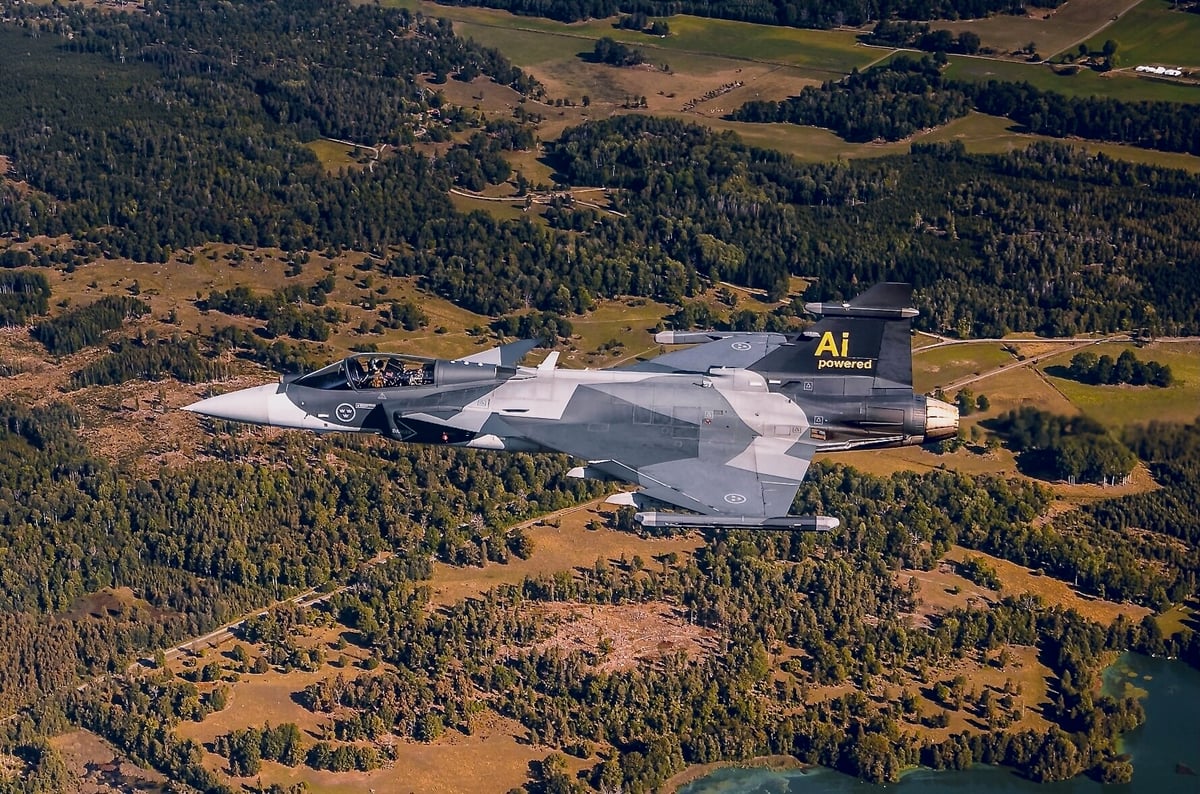
Key to the autonomous project is Saab’s AI Fighter Jet Pilot Academy, designed to develop the agents and, in parallel, establish infrastructure necessary to “create, train and evaluate” them, says the firm.
Saab Aeronautics has revealed that it has been developing and training its own artificial intelligence (AI) agents to perform and aid air combat tasks. Moreover, the Swedish defense group has been testing them in the air aboard the Gripen E fighter for ...
As stablecoins, real-time payment networks and artificial intelligence converge, financial infrastructure providers are confronting the fact that competitive questions are now becoming architectural ones. But building a system in which software can ...
AI is evolving at a rapid pace, and the uptake of Generative AI (GenAI) is revolutionising the way humans interact and leverage this technology. GenAI is
Frontier AI systems are beginning to test the limits of human oversight, while the companies developing them retain considerable power to define the risks
Accenture highlights that banks like JPMorgan Chase and Charles Schwab are restricting AI agents from their systems. Michael Abbott, Accenture's global banking lead, suggests that this strategy may negatively impact customer relationships.
There have been a series of papers published recently that showed that large language models have their own biases when making investment recommendations.
General-purpose mobile manipulation requires a combination of capable robot hardware, scalable demonstration collection, expressive whole-body control, and effective policy learning. Yet these components are often developed independently, creating mismatches that limit the capabilities of the complete system. We present Pixel, a co-designed full-stack system for learning general-purpose mobile manipulation. Pixel combines a low-cost wheeled humanoid with human-aligned kinematics and compliant grippers, multiple teleoperation and robot-free human data-collection interfaces, a unified whole-body controller, and a common policy learning pipeline across human and robot demonstrations. A hierarchical learning stack further enables language-conditioned visuomotor control and long-horizon task execution. We evaluate the system across hardware, data collection, and policy learning, and demonstrate mobile-manipulation behaviors requiring dexterity, active perception, navigation, and whole-body coordination. We hope that Pixel provides an integrated and extensible foundation for studying how robot hardware, data, control, and learning can be designed together for robot learning. More…
Idol turns one picture of an object into a 3D Gaussian splat. Give it a render, a generated image or a photo: it removes the background, frames the object and generates up to 1,048,576 Gaussians, written as a standard 3DGS .ply. It runs on consumer GPUs, using 7.2 GB of VRAM…
GitHub has not only added 4 million CPU cores and 160 PB of internal storage, but it is also rebuilding core Git primitives by decoupling compute from sto
Real-world document processing systems rely on rigid, predefined schemas, yet critical target fields often lack direct visual counterparts on the page. Extracting these implicit values requires multi-hop derivation, such as aggregating sub-categories or reasoning over visual…
Long-horizon autonomous intelligent systems rely on heterogeneous components such as large language models, databases, external APIs, and rule engines, while their external states continuously change during execution. Re-executing the entire workflow after every change…
Transformer models built on the attention mechanism have become a central building block in modern deep learning, yet softmax attention remains a major bottleneck for long-context workloads. While FlashAttention makes the forward and first backward passes I/O-efficient, it does…
In latent generative models, reconstruction quality is often assumed to correlate with generative performance. However, reconstruction FID (rFID) can exhibit weak or even negative correlation with generation FID (gFID). We attribute this misalignment to a latent distribution…